Search all Djerba island tours on GetYourGuide
Best Djerba Tours at a Glance
| Tour | Duration | Format | Approx. Price | Covers |
|---|---|---|---|---|
| Djerba Island Half-Day Tour | ~4h | Small group | From €30/person | Houmt Souk, La Ghriba, Guellala |
| Djerba Full-Day Island Tour | Full day (~8h) | Small group | From €40/person | Houmt Souk, La Ghriba, Djerbahood, crocodile farm |
| Private Djerba Circuit | Half–full day | Private | From €90 total | Flexible full-island itinerary |
Prices as of 2026. Check links for current availability and group size — some tours require a minimum of 4 participants.
Djerba is the Mediterranean island Tunisia does not quite fit into any category. It has the beach resorts (mostly on the northeastern coast) and the sunsets. It also has a medina that predates French colonialism by a thousand years, a Jewish community whose presence on the island is documented to at least the 6th century BCE, a pottery village that has been producing the same forms for generations, and one of the largest concentrations of contemporary street art anywhere in the world — painted directly onto the walls of a working village.
A single day tour of Djerba, done well, covers all of this. This page explains the strongest verified options.
1. Djerba Full-Day Island Tour
This is the most complete single-day introduction to Djerba’s culture and heritage. It covers the four main sites — Houmt Souk, La Ghriba synagogue, Guellala pottery village, and the Djerbahood street art circuit — with enough time at each to form a genuine impression rather than a glimpse from a minibus window.
Houmt Souk: The main town of Djerba, Houmt Souk is built around a fortified harbour and a medina that grew through successive layers of Berber, Arab, Ottoman, and Andalusian settlement. The 15th-century Borj El Kebir fortress (also called Gazi Mustafa fort) sits at the harbour’s edge and contains a small museum covering the island’s history. Inside the medina, the main souks concentrate on jewellery (Djerba produces distinctive silver work), textiles, and traditional pottery. The fish market near the port is worth an early-morning visit — it runs from around 7am and is over by 9am.
La Ghriba synagogue: Seven kilometres southwest of Houmt Souk, in the village of Erriadh, La Ghriba (literally “the stranger”) is one of the oldest active synagogues in the world. Tradition holds that a stone from Solomon’s Temple or a door from the First Temple was brought here after the Temple’s destruction — the documentary evidence is older: the island’s Jewish community dates to at least the 6th century BCE, when Jewish priests fled Jerusalem before the Babylonian conquest. The interior is decorated with blue and white tilework, enamel lamps, and carved wooden panels. Modest dress is required.
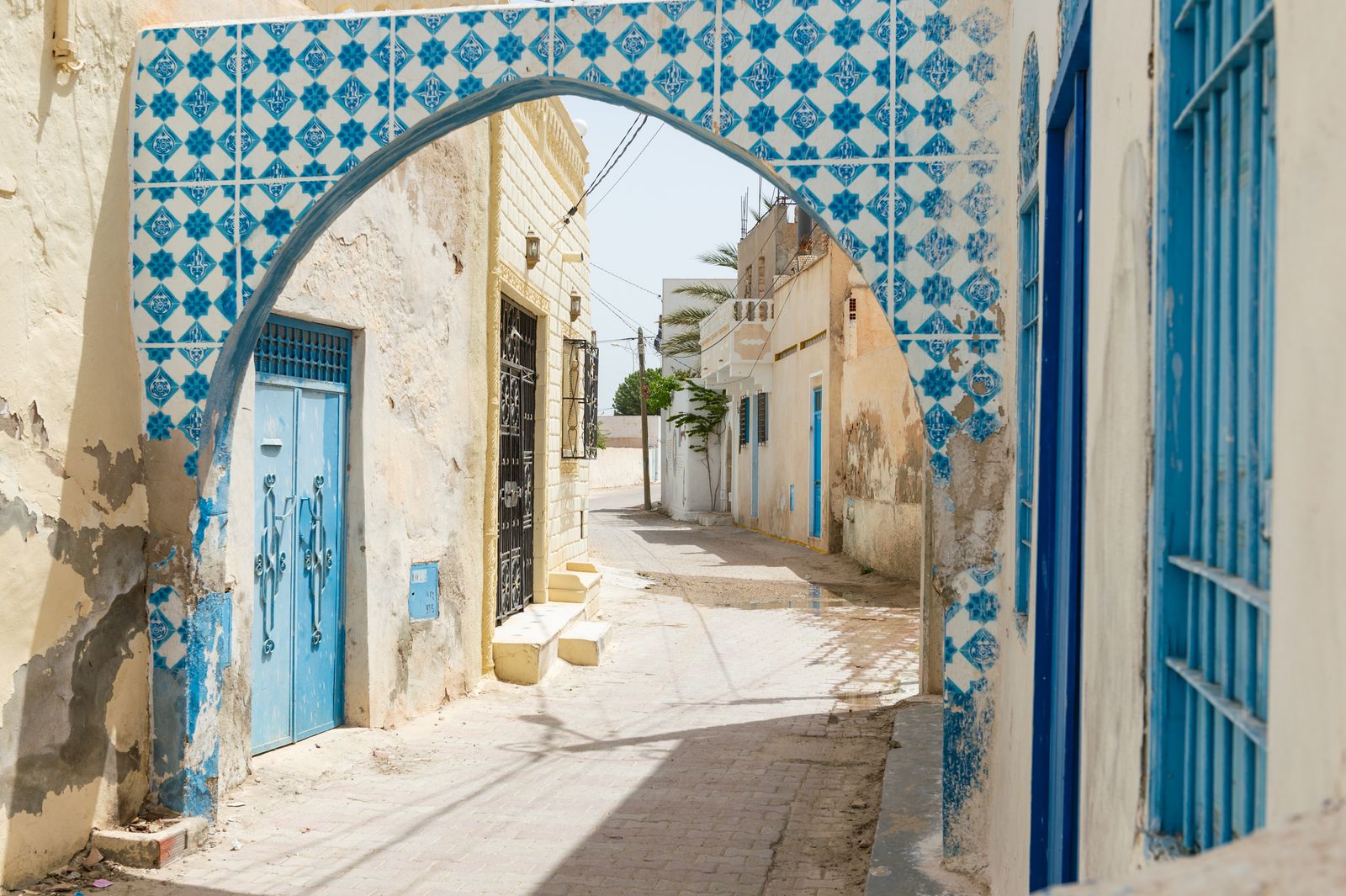
Djerbahood: The street art village of Erriadh surrounds La Ghriba. Beginning in 2014, the Djerbahood project commissioned murals from artists from across Africa, Europe, and the Arab world, painted onto the whitewashed walls of this residential village. The work ranges from large-scale figurative painting to abstract geometric pieces, and it coexists with washing lines and children on bicycles in a way that gallery installations rarely manage. An hour wandering the alleys is enough to see the main pieces; a guided tour identifies the artists and the stories behind specific murals.
Guellala: On the southern coast, the village of Guellala has been a pottery production centre since the Roman period. The pale grey clay from the surrounding hills produces distinctive amphorae, cooking vessels, and decorative jars that differ from the blue-and-white painted pottery of Nabeul — earthier in tone and purpose. Several workshops allow visitors to watch production. The village museum (Musée de Guellala) covers the island’s ethnographic traditions with reconstructed domestic scenes; entry approximately 8 TND.
What to expect on the full-day tour: Departure is typically from the hotel zone or Houmt Souk, running from approximately 9am to 5pm. Group size is usually 8 to 15 people. The pace allows genuine exploration at each site rather than a strict schedule.
Price range: Group full-day tours from approximately €40 to €65 per person. Private tours for two covering all four sites cost approximately €120 to €180 depending on the operator and whether lunch is included.
Book the Djerba full-day island tour
2. Djerba Half-Day Tour
For visitors with limited time — or those arriving later in the day — a focused half-day tour typically covers Houmt Souk, La Ghriba, and one additional site, usually Guellala or a stop in the Djerbahood village.
Who it suits: Travellers who have already explored the hotel zone and want a cultural half-day without committing to a full day. The half-day format also works well for families with young children for whom a full eight-hour tour would be too much.
What to expect: The half-day typically runs from 9am to 1pm or 2pm to 6pm. The afternoon slot is often preferred for La Ghriba — the light inside the synagogue is better in the afternoon, and the Djerbahood murals show better in direct afternoon light.
Price range: Group half-day tours from approximately €30 per person. Private half-day tours for two cost approximately €90 to €120.
Book the Djerba island half-day tour
3. Houmt Souk Medina Walking Tour
The Houmt Souk medina rewards a slow walk more than most in Tunisia. It is small enough to cover completely in two hours but layered enough that without guidance the most interesting parts — the fondouks (former merchants’ inns), the Ottoman-period mosques, the silver jewellery workshops — are easily missed.
What a guide adds: The medina’s fondouks are the most distinctive architectural feature of Houmt Souk. These double-storey courtyard buildings were originally caravanserais where merchants stayed above their goods. Several are now converted to craft shops or hotels; the best-preserved open onto irregular courtyards that the street gives no indication of. A guide also explains the layered settlement history — the Jewish quarter (hara) was historically adjacent to the medina — and points out the Ottoman-period mosques whose minarets are octagonal rather than cylindrical, a Tunisian architectural tradition.
Duration: One to two hours for a focused medina walk. Most standalone medina tours cover the Borj El Kebir entrance, the main souks, one or two fondouks, and the harbour.
Price range: Private medina walking tours typically cost €40 to €60 per guide for a small group of up to four people.
4. Djerba Crocodile Farm
The Djerba Explore complex near the hotel zone includes a crocodile farm housing over 400 Nile crocodiles at various stages of growth. It is not everyone’s idea of cultural tourism, but the facility is well run and the feeding demonstrations are genuinely dramatic. The adjacent heritage village reconstruction (traditional Djerban architecture) adds context.
What to expect: The crocodile farm runs feeding sessions at scheduled times daily — check current times on arrival. The largest individuals exceed 4 metres and weigh over 300 kg. Entry is approximately 25 TND for adults (2026). The full visit, including the heritage village, takes 90 minutes to two hours.
How it fits in: Most full-day island tours include the crocodile farm as a final stop after Guellala. If you prefer to skip it, a private tour can omit the site without losing time.
5. Coastal and Fishing Village Circuit
Djerba’s north coast road, running between Houmt Souk and the northeastern beach zone, passes through a series of small fishing villages — Ajim, Mahboubine, El Kantara — where traditional wooden fishing boats (called feluccas locally) are built and repaired. This circuit has less organised tour infrastructure than the cultural sites but rewards independent exploration by scooter or hired car.
El Kantara: The village at the island’s southeastern tip sits at the foot of the Roman causeway connecting Djerba to the mainland. The original Roman road is partially visible at low tide. The crossing itself takes about fifteen minutes by ferry (the causeway road is longer but more commonly used). A small fishing port with cafes overlooking the water makes this a reasonable lunch stop.
Flamingo Point (Ras Rmel): At the western tip of the island, the sand spit at Ras Rmel is a known flamingo feeding ground between October and March. There is no formal tour infrastructure — it is an unmarked sand track from the coastal road — but the sight of several hundred flamingos in the shallows of the lagoon is worth the detour for wildlife-oriented travellers.
Booking Tips for Djerba Tours
Group vs private: For the main island circuit (Houmt Souk, La Ghriba, Guellala, Djerbahood), group tours are well-organised and the logistics are straightforward. Private tours are worth the premium for the medina walk and for any coastal circuit involving smaller villages, where flexibility makes a real difference.
Timing around La Ghriba: The synagogue closes for the Lag B’Omer pilgrimage period (usually in May) and on Jewish holidays. Confirm access when booking if your visit falls around these dates. Outside pilgrimage season, visits are typically between 9am and 5pm.
Getting around Djerba independently: Scooters hire for approximately 40 to 50 TND per day from several outlets near the Houmt Souk harbour — the island’s roads are flat and mostly quiet, making scooter circuits very practical for those comfortable on two wheels. Hire cars are available from the airport and major hotels.
Avoiding the hotel zone tours: Several operators based in the hotel zone (Zone Touristique) offer “island tours” that spend significant time at souvenir shops with commission arrangements for the guide. These typically run cheaper (from €20) but deliver less site time. Booking directly through GetYourGuide avoids the commission-stop problem.