Search hotels in Djerba on Booking.com
Compare Djerba Island Tours
Three verified GetYourGuide options - a half-day cultural walk, a full-day island circuit, and a half-day from Houmt Souk:
| Tour | Duration | Format | Price | Covers | Book |
|---|---|---|---|---|---|
| Djerba Island Half-Day Tour | ~4 hours | Small group | From ~€35/person | Houmt Souk medina, La Ghriba synagogue, Guellala pottery | Book |
| Djerba in 1 Day: Island Tour, Authentic Sites & Crocodile Park | Full day (~8h) | Small group | From ~€65/person | Houmt Souk, La Ghriba/Djerbahood, Guellala, crocodile farm | Book |
Which to choose: The half-day tour is the right pick if you’re based on the island and want a structured morning covering La Ghriba and the pottery village with a local guide - particularly if you’ve already explored Houmt Souk independently. The full-day circuit is the better option for visitors arriving from the mainland or those who want everything in a single organised day, including the crocodile farm which is hard to reach without your own transport.
Prices as of 2026. Check links above for current availability - tours run most days in season (April–October).
Djerba is Tunisia’s largest island and one of North Africa’s most visited destinations. At roughly 510 square kilometres, it is small enough to explore thoroughly in a day and varied enough to justify staying longer. The island combines a working fishing and trading community at Houmt Souk, one of the oldest synagogues in Africa at Erriadh, a pottery craft tradition at Guellala, and a coastline of long sandy beaches backed by tourist resorts.
Organised tours cover the cultural circuit efficiently and provide context that is hard to replicate independently. This page covers what each site involves, what tours typically include, and how to find operators.
Houmt Souk - Island Capital and Market Town
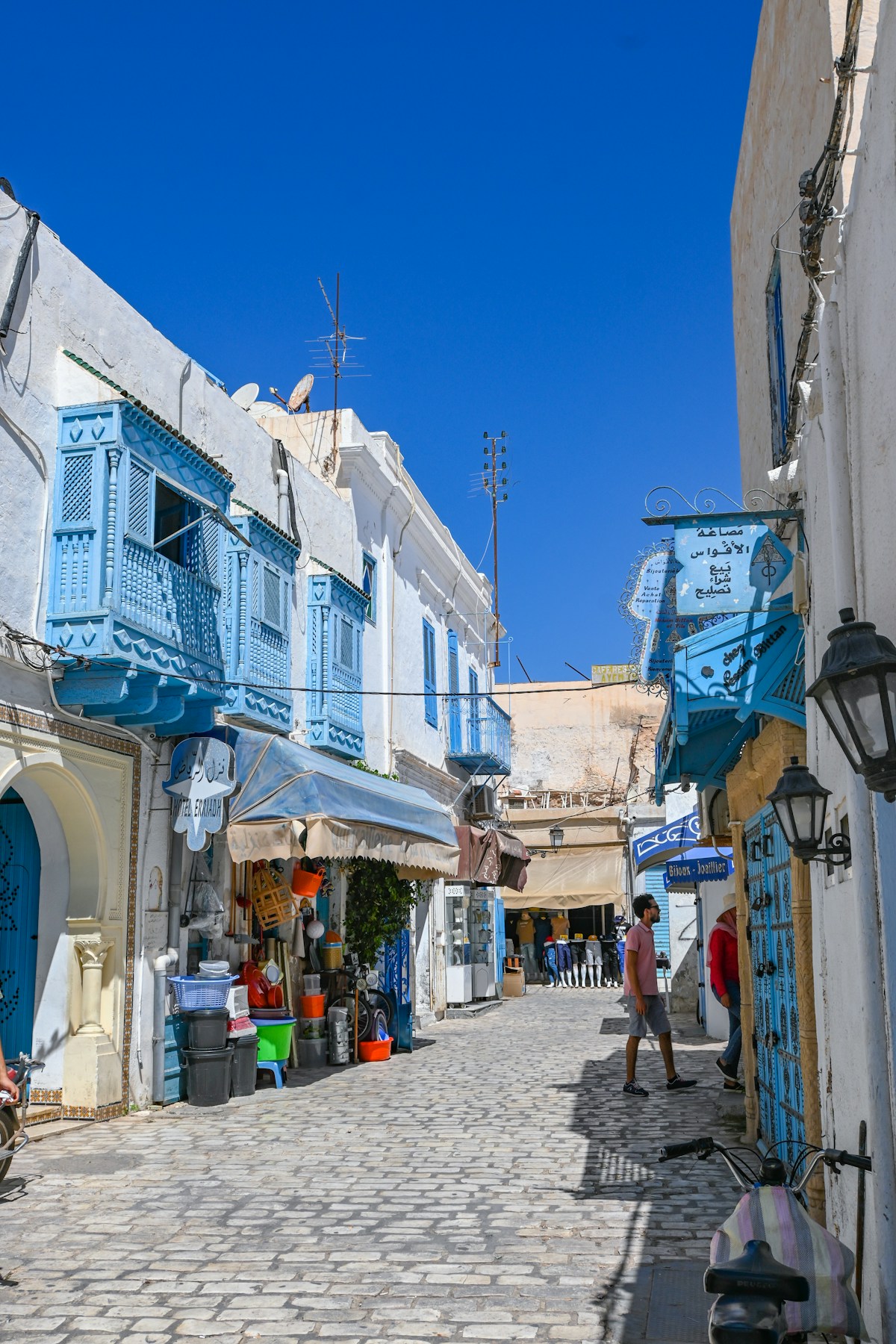
Houmt Souk (“the market quarter”) is Djerba’s main town and the hub of island life. The central medina is compact and walkable, built around a series of covered souk streets selling spices, ceramics, silver jewellery, and woven cloth. The architecture is distinctly different from mainland Tunisia - low whitewashed structures with blue-painted ironwork balconies, and fondouks (caravanserais) converted into craft workshops and restaurants.
Borj el Kebir (the Great Fort), a 15th-century coastal fortress at the edge of Houmt Souk harbour, is the town’s primary landmark. Built by the Hafsid dynasty and expanded by the Spanish and Ottomans, it overlooks the fishing boats and ferry traffic of the harbour. Entry costs approximately 7 TND as of 2026. Opening hours are typically 8am–7pm (shorter in winter).
Walking tour operators based in Houmt Souk run 2–3 hour guided circuits of the medina covering the main fondouks, the souk streets, and Borj el Kebir. These run most mornings and can be booked via GetYourGuide (search “Djerba”) or through hotel concierges. Half-day tours typically run 80–130 TND per person as of 2026.
La Ghriba Synagogue, Erriadh - Oldest Synagogue in Africa
La Ghriba (“the miraculous stranger”) is located in the village of Erriadh, approximately 8 km southwest of Houmt Souk. The current building dates from the 19th century, but the site’s founding is attributed to Jewish settlers who arrived in Tunisia following the destruction of the First Temple in Jerusalem in 586 BCE - making it one of the oldest active Jewish places of worship on the continent.
The interior is lined with blue and white Andalusian tiles, ceramic pillars, and iron chandeliers. At the heart of the sanctuary is a carved wooden ark said to contain a stone from the ancient Temple of Solomon. The atmosphere is calm and visually remarkable even for visitors with no religious connection to the site.
Every year at Lag BaOmer (a Jewish festival falling 33 days after Passover - typically in May), thousands of Jewish pilgrims from across North Africa, Israel, France, and the Americas make a pilgrimage to La Ghriba. During this period, public visits are restricted.
- Entry: approximately 7 TND as of 2026
- Dress code: modest clothing required; head coverings provided
- Getting there: 8 km from Houmt Souk, easily accessible by taxi (approximately 10–15 TND return) or as part of an island tour
Guellala - The Pottery Village
Guellala sits on the southern coast of Djerba, about 15 km from Houmt Souk. The village has been a centre of pottery production since antiquity - the local clay and the tradition of low-temperature wood firing producing a distinctive earthy red and yellow ware that differs from the brighter glazed ceramics sold in the medinas.
The workshops are mostly family-run and open to visitors. Prices for pieces directly from the potters are typically lower than in Houmt Souk shops - a medium-sized storage jar might run 20–50 TND as of 2026 from a workshop, compared to 40–80 TND in the market. Watch for demonstrations of wheel-throwing and kiln-loading.
The Guellala Museum (Musée de Guellala) presents a collection of life-size tableaux depicting traditional Djerban life - weddings, harvests, domestic scenes - alongside a ceramics display. Entry is approximately 5 TND as of 2026.
Most full-day island tours include a Guellala stop of 45–90 minutes.
Djerbahood - Street Art Village
Erriadh village (same village as La Ghriba) was transformed in 2014 into Djerbahood, an open-air gallery featuring over 250 murals by international street artists. Commissioned by the Tunisian artist Mehdi Ben Cheikh, the project brought artists from more than 30 countries to paint the exterior walls of the village’s houses, lanes, and abandoned buildings.
The murals range from large-scale figurative portraits to abstract geometric work and political commentary. The project was one of the largest street art interventions in the Arab world and drew significant international attention.
Walking the village takes about an hour. There is no admission charge. The La Ghriba synagogue and Djerbahood are in the same village and most tours combine them.
Crocodile Farm (Les Crocodiles de Djerba)
The Djerba Explore complex on the northeast coast of the island includes a crocodile farm that houses several hundred Nile crocodiles across a series of pools and enclosures. It is primarily a family attraction rather than a conservation facility.
The farm connects to a reconstructed traditional village (the Lalla Hadria Museum) with exhibits on Tunisian crafts, dress, and daily life.
- Entry to crocodile farm: approximately 15 TND per adult, 8 TND for children as of 2026
- Opening hours: typically 9am–5pm, extended in peak summer months
- Location: Route Touristique, northeast coast of Djerba, near the resort strip
Organising a Tour
Full-day island circuit: The most efficient way to cover Houmt Souk, La Ghriba/Djerbahood, Guellala, and the crocodile farm in a single day. These run frequently in high season (April–October) and can be booked via GetYourGuide, Viator, or hotel tour desks on the island. Expect to pay approximately 180–300 TND per person as of 2026 for a guided group tour with transport.
Private island tours: Allow you to spend more time at the sites that interest you most. A private driver and vehicle for a full-day island circuit costs approximately 250–400 TND for up to 4 people as of 2026. Your hotel can arrange this or you can negotiate with drivers at Houmt Souk.
Half-day Houmt Souk walking tours: Best for those who have only a morning or afternoon spare. GYG-listed operators in Djerba run these most days in season.
From the mainland: Operators in Sfax, Gabès, and Sousse run day trips to Djerba that combine the ferry crossing with a guided island circuit. These are longer days (typically 10–12 hours) but cover the main highlights efficiently.
Practical Notes
- Getting to Djerba: Djerba-Zarzis International Airport (DJE) connects directly to Tunis, Paris, Lyon, Brussels, and other European cities. By road, the main approach is via the causeway from Zarzis (4 km) or the ferry from Jorf on the mainland to Ajim on Djerba (15 minutes, runs 24 hours, fare approximately 1 TND per person plus vehicle as of 2026).
- Getting around the island: Taxis, rental bicycles, and scooters (available from Houmt Souk, approximately 60 TND per day) are the main independent options. The island is flat and cycling is practical in cooler months.
- When to visit: April–June and September–October for comfortable temperatures. July and August are hot and the beach resorts are at maximum capacity.
Our Djerba destination guide covers the wider island in detail. For accommodation, see our where to stay in Djerba guide. If you are deciding between Djerba and Monastir for a beach holiday, our Djerba vs Monastir comparison covers each destination’s strengths side by side. Browse tours and activities on Djerba to find current availability for island circuits, Ghriba visits, and boat excursions. For same-day or next-day options, our last-minute tours page lists Djerba experiences with immediate availability.