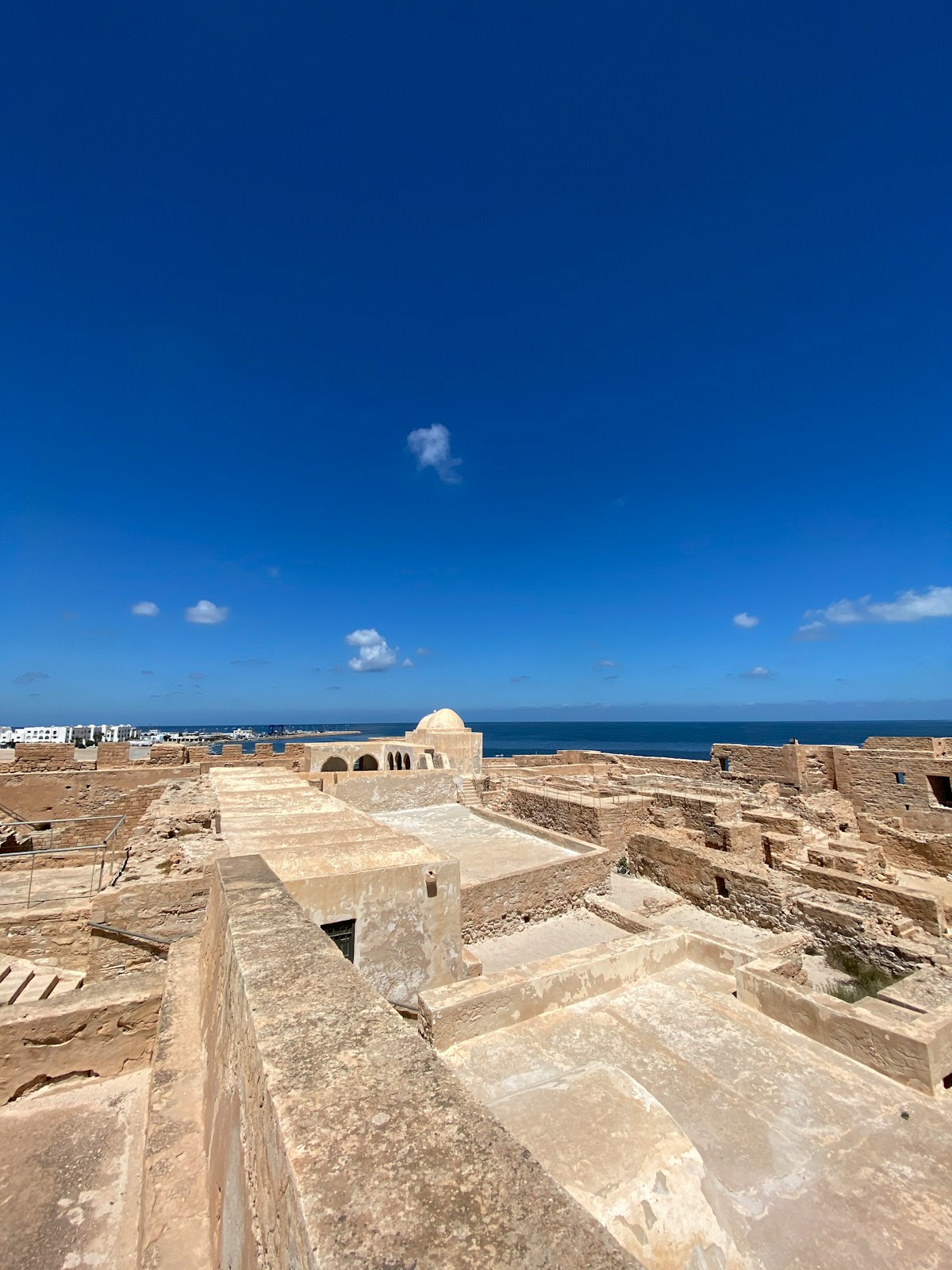
Tunisia has two distinct approaches to a beach-focused holiday: the island experience of Djerba - North Africa’s largest island with wide shallow beaches and strong resort infrastructure - and the quieter mainland charm of Monastir, a smaller city on the Gulf of Hammamet with a magnificent Ribat fortress and a more contained resort zone near its international airport.
Both are well-served by direct European flights. Both have cultural sites alongside the beach. The difference is in atmosphere, beach quality, and who they suit.
At a Glance
| Djerba | Monastir | |
|---|---|---|
| Type | Island resort, 514 km² | Mainland coastal city |
| Distance from Tunis | ~490 km | ~160 km |
| Airport | Djerba-Zarzis International | Monastir Habib Bourguiba International |
| Beach quality | Wide, very shallow, calm (Gulf of Gabès) | Good width, calmer than open Med |
| Sea conditions | Exceptionally calm, very shallow | Moderate, generally calm |
| Cultural assets | El Ghriba synagogue, Houmt Souk, Borj el Kebir | Ribat (outstanding), Bourguiba Mausoleum |
| Resort infrastructure | Very large all-inclusive hotels | Concentrated Skanes zone |
| Best for | Beach purists, families, island feel | Quiet resort, heritage, couples |
| Avoid if | You want quick Tunis access | You want the biggest beach and water park |
Quick verdict: Djerba wins on pure beach quality and family appeal, especially for the unique shallow water conditions. Monastir suits travellers who want a quieter holiday with a strong single cultural attraction (the Ribat) and a short transfer from the airport.
Djerba
What it is
Djerba is connected to the mainland by a Roman-era causeway and served by its own international airport - making it the most self-contained and easiest-to-reach Tunisian resort for direct European visitors. The island covers 514 square kilometres; the tourist infrastructure is concentrated on the north coast, particularly around Sidi Mahres and the Midoun area, where the hotel strip runs along a broad bay.
The island has a distinctive cultural character: it has been home to a significant Jewish community for over two millennia, and the El Ghriba synagogue (in the interior village of Er-Riadh) is one of the oldest functioning synagogues in the world and an annual pilgrimage site. The main town, Houmt Souk, has a working market, a Genoese-Ottoman fort, and a craft tradition in mergoum rugs that is specific to the region.
The beach
The north coast beaches are Djerba’s defining feature. The Gulf of Gabès is very shallow - in places you can walk several hundred metres from shore in waist-deep water. The sand is fine and pale; the water temperature is warm and the sea surface is exceptionally calm for most of the year. This is genuinely among the best beach environments in the Mediterranean for families with young children.
The main hotel beach zone is long - several kilometres of largely continuous beach from Sidi Mahres to the southeast. Sun loungers and umbrellas are generally managed by the hotels but public beach access exists.
Culture in Djerba
- El Ghriba Synagogue (Er-Riadh village): entry approximately 3 TND; one of the most historically significant Jewish sites in the world. Open daily except Saturday. The annual Lag Ba’Omer pilgrimage draws thousands in May.
- Borj el Kebir (Houmt Souk): coastal fort, entry approximately 5 TND; views over the harbour
- Houmt Souk market: the main commercial district of the island, lively in mornings
- Guellala pottery village: the island’s traditional ceramics centre, with workshops open to visitors
For a half-day guided circuit of El Ghriba, Houmt Souk, and the pottery village, browse Djerba island tours on GetYourGuide. For the full range of Djerba excursions and day trips, see our Djerba tours guide.
Hotels in Djerba
- Yadis Djerba Golf Thalasso & Spa: luxury five-star on the beach; from approximately 450–800 TND per night as of 2026
- Seabel Rym Beach Djerba: large four-star all-inclusive; from approximately 300–550 TND per night
- Diar Yassine (Houmt Souk area): boutique guesthouse, authentic atmosphere; from approximately 120–200 TND per night
Search hotels in Tunisia on Booking.com
Restaurants in Djerba
- Restaurant Haroun (Houmt Souk, port): best fish restaurant on the island, popular with locals and visitors; approximately 50–90 TND per person
- Restaurant Dar Faiza: traditional Djerbian cuisine in a restored house; approximately 40–70 TND per person
- Houmt Souk market stalls: brik, sandwiches, and grilled meats; approximately 5–15 TND
Monastir
What it is
Monastir is a modest city of around 80,000 people on a small headland on the Gulf of Hammamet. Its international airport - Monastir Habib Bourguiba International - is one of the busiest entry points for European tourists visiting the central coast. The city was the birthplace of Habib Bourguiba, Tunisia’s founding president, and this connection gives it a civic pride and some distinctive architecture beyond what you’d expect from a town of its size.
The Ribat
The Ribat is Monastir’s main attraction - a fortified Islamic monastery built in the 8th century on the seafront. It is one of the finest surviving examples of ribat architecture in the Maghreb and has appeared in multiple films, including Monty Python’s Life of Brian. Entry costs approximately 8 TND as of 2026; the towers give views across the medina and out to sea that are worth the climb alone. Visiting in the golden hour before sunset is particularly rewarding.
The beach
Monastir’s best beaches are in the Skanes zone - the resort strip between the airport and the town - where the beaches are wider and less urban than the town beach itself. The sea at Monastir is calmer than the open Mediterranean but not as exceptionally still as the Gulf of Gabès at Djerba. Suitable for families and comfortable swimming; less perfect for very young children than Djerba.
Hotels in Monastir
- Regency Hotel and Spa Monastir (beachfront): four-star with thalassotherapy; from approximately 220–380 TND per night as of 2026
- Iberostar Selection Kantaoui Bay (Port El Kantaoui): large five-star all-inclusive; from approximately 350–600 TND per night
- Hotel El Habib (Skanes): well-located four-star, solid facilities; from approximately 180–300 TND per night
For guided tours of the Ribat, medina, and the Monastir coastline, see our Monastir tours guide.
Restaurants in Monastir
- Restaurant Neptune (port area): reliable for fresh fish and grilled seafood; approximately 35–60 TND per person
- Restaurant du Port: local favourite, straightforward and fresh; approximately 25–40 TND per person
- Medina cafés and snack restaurants: approximately 10–20 TND per person
Getting Between Djerba and Monastir
These two destinations are not easy to combine in transit - they are around 330 kilometres apart by road, and no direct public transport connects them.
By louage via Sfax:
- Djerba (airport or town) to Sfax: approximately 2.5 hours, approximately 25–30 TND per seat
- Sfax to Monastir: approximately 1.5 hours by louage or 2 hours by train; approximately 12–18 TND Total: approximately 4–5 hours, approximately 37–48 TND
By train via Sfax: Train from Sfax to Monastir is comfortable; the Djerba to Sfax leg requires a louage (no train). Total journey with connection: approximately 5 hours.
By car: Approximately 3 to 3.5 hours. The road runs up the coast through Sfax - the most practical option for travellers with a rental car. Compare car hire rates in Tunisia to lock in a price before you arrive.
By air: Domestic flights between Djerba and Tunis (then connection to Monastir area) exist but are expensive and rarely faster than driving when accounting for airport time.
Which to Choose?
Choose Djerba if:
- Beach quality is your top priority - the shallow Gulf of Gabès is genuinely exceptional
- You’re travelling with young children (the water depth advantage is significant)
- You want an island atmosphere and feel
- You want the most developed large-scale all-inclusive resort infrastructure
- You’re interested in the El Ghriba synagogue or Djerba’s distinctive cultural heritage
Choose Monastir if:
- The Ribat and the fortress architecture is a draw
- You want a quieter, smaller-scale resort experience
- You’re flying in on a charter to Monastir airport and don’t want to transfer
- You want to combine with a trip north to Sousse or Tunis (much easier from Monastir)
- You prefer a town that functions beyond its tourist trade
The practical consideration: Djerba is at the southern end of Tunisia; Monastir is in the centre. If you want to combine a beach holiday with visits to Tunis, Carthage, or Sousse, Monastir is dramatically better positioned. If the beach itself is the entire point of the trip, Djerba is the superior choice.
For more on beaches around Tunisia, see our Hammamet vs Djerba vs Sousse comparison and our getting around Tunisia guide. For accommodation, see our where to stay in Djerba and best hotels in Monastir guides. For Djerba’s beaches in detail, our Djerba beaches guide covers each stretch of coastline. Make sure travel insurance for Tunisia is in place before you travel.
Plan Your Trip
✈️ Book your flights to Tunisia 🛡️ Get travel insurance 📱 Stay connected with an eSIM 🚗 Rent a car