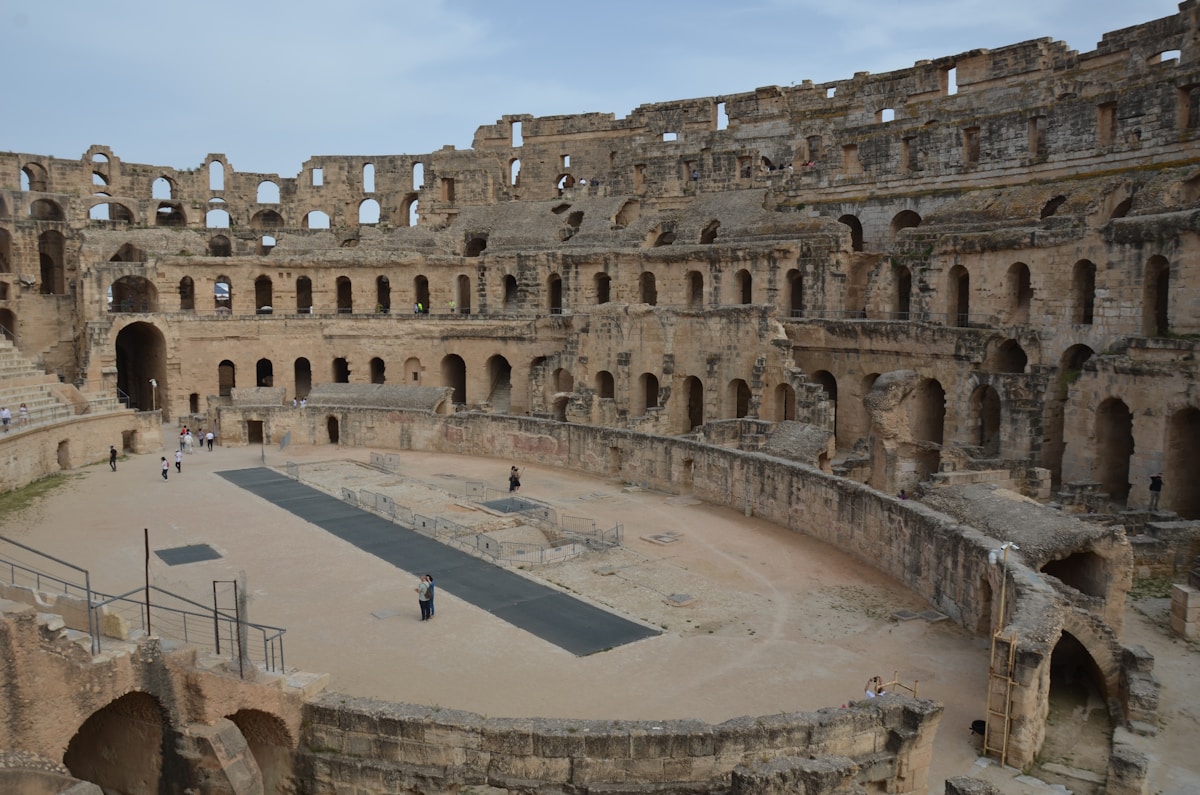
At its height, Carthage was the third-largest city in the Roman Empire - a fact that tends to surprise visitors standing among today’s low ruins. The ancient site sits just 30 minutes north of Tunis by TGM light rail, making it the most accessible UNESCO World Heritage site in the country.
The ruins cover a wide coastal area: Roman baths, Punic ports, a hilltop museum, and an ancient residential quarter, all reachable with a single combined ticket (approximately 15 TND as of 2026). A half-day covers the highlights; a full day lets you explore properly and continue one TGM stop north to Sidi Bou Saïd.
This guide covers every site in detail, with TGM stop-by-stop logistics, entrance fees, opening hours, and how to build the classic Tunis day trip around Carthage.
A brief history of Carthage
The Punic city (c.814–146 BC)
Carthage was founded around 814 BC, according to ancient tradition, by Phoenician settlers from Tyre - the founding queen Dido (Elissa) is the central figure of the founding myth. The city grew to become one of the ancient Mediterranean’s most powerful states, controlling trade routes across the western Mediterranean from bases in Sicily, Sardinia, and the Iberian Peninsula.
At its peak, Carthage may have held a population of 300,000–500,000, with a sophisticated double harbour (one commercial, one military), monumental temples, and a city area rivalling Rome. Three wars against Rome - the Punic Wars - tested and eventually broke Punic power. After the Third Punic War, Rome destroyed the city systematically in 146 BC, famously salting the earth (though historians debate the literal truth of this). Most Punic structures above ground were demolished.
Roman Carthage (c.44 BC–439 AD)
Julius Caesar and later Augustus refounded Carthage as a Roman colony - Colonia Iulia Concordia Carthago - from around 44 BC. The Roman city was built largely over and around Punic remains. It grew to become the third-largest city in the Roman Empire after Rome and Alexandria, and the capital of the province of Africa Proconsularis.
The Antonine Baths, built under Emperor Hadrian and completed under Antoninus Pius in the 2nd century AD, are the most visible monument of this Roman city. Early Christianity took strong root in Carthage - Tertullian and later Augustine were both associated with the city.
Roman Carthage fell to the Vandals in 439 AD and later became part of the Byzantine Empire before the Arab conquest in the 7th century ended it as a major urban centre.
What the TGM stops at Carthage
The most efficient way to navigate the spread-out site is by knowing which TGM station serves which area. The TGM line runs from Tunis Marine northward along the coast.
| TGM Station | What’s nearby |
|---|---|
| Carthage Salammbô | Punic Ports, Tophet (Punic sanctuary), Circular Harbour museum |
| Carthage Dermech | Baths of Antoninus (Antonine Baths) - the most-visited site |
| Carthage Byrsa | Byrsa Hill, National Museum of Carthage, Punic residential quarter |
| Carthage Présidence | Northern residential areas, less-visited archaeological zones |
The stations are 5–10 minutes apart on the train. A practical approach is to start at Salammbô (Punic Ports), take the train one stop to Dermech (Baths of Antoninus), then one more to Byrsa (museum) - this follows both historical chronology and geographic logic.
Entrance fees and opening hours
Combined ticket: Approximately 15 TND (subject to change). Covers the main sites including the Baths of Antoninus, National Museum, Punic Ports, and Tophet. Tickets are sold at each site - there is no single central ticket office.
Individual tickets: Available at each site if you only want to visit one or two areas.
Opening hours:
- Summer (April–September): 8:00–19:00
- Winter (October–March): 8:30–17:00
- Closed on public holidays
Arriving before 10:00 is recommended at the Baths of Antoninus - tour groups arrive mid-morning and the light is better earlier in the day.
Key sites in Carthage
Baths of Antoninus (Carthage Dermech station)
The most striking single site at Carthage. These Roman baths were among the largest in the ancient world - only the Baths of Caracalla and Diocletian in Rome were larger. Even in their current ruined state, the scale is impressive: the surviving columns (partially re-erected) and the clifftop setting above the sea give a strong sense of the original building’s ambition. The Baths were built in the 2nd century AD under Hadrian and Antoninus Pius.
This is usually the first stop for most visitors and the site that photographs best.
Byrsa Hill and National Museum of Carthage (Carthage Byrsa station)
The ancient heart of Carthage, now home to the National Museum of Carthage. The hilltop gives panoramic views over the site and the coastline north of Tunis. The museum houses Punic and Roman artefacts - funeral steles, statuary, pottery, and objects from everyday life - that help contextualise the ruins elsewhere on the site. Allow 1–1.5 hours.
The Punic residential quarter on the slopes of Byrsa is one of the best-preserved areas of the original city - a grid of narrow streets and house foundations gives a tangible sense of urban Punic life before the Roman destruction.
Punic Ports (Carthage Salammbô station)
The ancient harbours - one commercial, one military (the military port was circular, unique in the ancient world) - are now partially archaeological sites with an on-site museum. They give a strong sense of Carthage as a maritime power before Roman conquest. The military harbour, called the Cothon, held berths for around 220 warships according to ancient sources.
The ports area is less dramatic visually than the Baths but historically significant. The museum here has scale models that help visitors understand the original layout.
Tophet (Carthage Salammbô station)
The Tophet is a Punic sanctuary adjacent to the ports area, containing rows of stelae (stone markers) and funerary urns. It is one of the most archaeologically sensitive sites at Carthage - ancient sources including Diodorus Siculus described child sacrifice here, but modern scholars debate whether the urns contain sacrificed children, children who died naturally, or a combination. The site is evocative and the debate is genuine: the interpretation panels at the site present both positions.
Roman villas and residential areas
The area between the Baths and Byrsa contains Roman villa remains with mosaic fragments. These are less visually dramatic but add texture to the picture of daily life in Roman Carthage.
How to visit Carthage
By TGM: Take the TGM from Tunis Marine station (runs every 20–30 minutes; ticket ~2 TND). Get off at Carthage Salammbô for the ports and Tophet, Carthage Dermech for the Baths, or Carthage Byrsa for the museum. The journey is around 25–30 minutes from Tunis Marine.
By taxi: A return taxi from the centre of Tunis to Carthage and back costs approximately 25–40 TND depending on negotiation. Useful if covering the full site in one sweep rather than TGM-hopping.
On foot between stations: The walk between Carthage Dermech and Carthage Byrsa takes about 20 minutes. The full site on foot is manageable but involves some hills.
Guided tours: From Tunis, several operators offer guided half-day or full-day Carthage visits including transport. A guide adds significant value - the story of the site is part of what makes the visit meaningful, and the ruins themselves are not always well-labelled. Booking a Tunis, Carthage and Sidi Bou Said tour is the most popular way to cover both sites in a single day. If time is tight, the half-day tour from Tunis to Carthage and Sidi Bou Said covers the highlights in around four hours.
Combining Carthage with Sidi Bou Said
This is the classic Tunisia day trip from Tunis. Carthage in the morning gives historical depth; Sidi Bou Said (one more stop north on the TGM) in the afternoon provides café stops, sea views, and a completely different atmosphere. The combination is one of the strongest single-day outings in the country. See our Tunis, Carthage & Sidi Bou Said tour guide. If you’re only able to choose one of the two for a morning, our Sidi Bou Said vs Carthage comparison helps you decide. It’s also worth sorting travel insurance before you depart - it covers delays and unexpected cancellations if plans change.
Festival International de Carthage
Each summer (July–August), the Roman amphitheatre hosts the Festival International de Carthage - Tunisia’s flagship performing arts event since 1964. International and Tunisian musicians, dancers, and theatre companies perform to audiences of up to 8,000 in one of the Mediterranean’s most dramatic open-air venues. Tickets go on sale in advance and popular acts sell out fast.
How much time do you need?
Half a day is enough to see the Baths of Antoninus, Byrsa Hill, and the museum at a reasonable pace. A full day allows a more relaxed exploration of the full site including the Punic Ports, Tophet, and residential areas, plus time for lunch in the area. Most first-time visitors combine a morning at Carthage with an afternoon in Sidi Bou Said. For a detailed breakdown of how to prioritise and sequence the sites, see our things to do in Carthage guide.
Tips for your visit
- Water and shade: The Antonine Baths have almost no shade in summer. Bring 1.5 litres per person and a hat. Byrsa Hill has more tree cover.
- Footwear: Uneven stone and gravel paths throughout. Trainers or walking shoes are better than sandals.
- Photography: The Antonine Baths look best in morning light (before 11:00 in summer). The view from Byrsa Hill is clearest in the early afternoon when haze settles.
- Crowds: The site is busiest from 10:00 to 13:00 on weekends and during French school holidays. Arriving at 08:30 gives you the ruins largely to yourself.
- Guides: Licensed guides are available at the main sites for approximately 30–50 TND for 2 hours. Worth considering for the Tophet and museum, where historical context adds considerably to the visit.
Search hotels in Tunis on Booking.com
Plan Your Trip
✈️ Book your flights to Tunisia 🛡️ Get travel insurance 📱 Stay connected with an eSIM 🚗 Rent a car