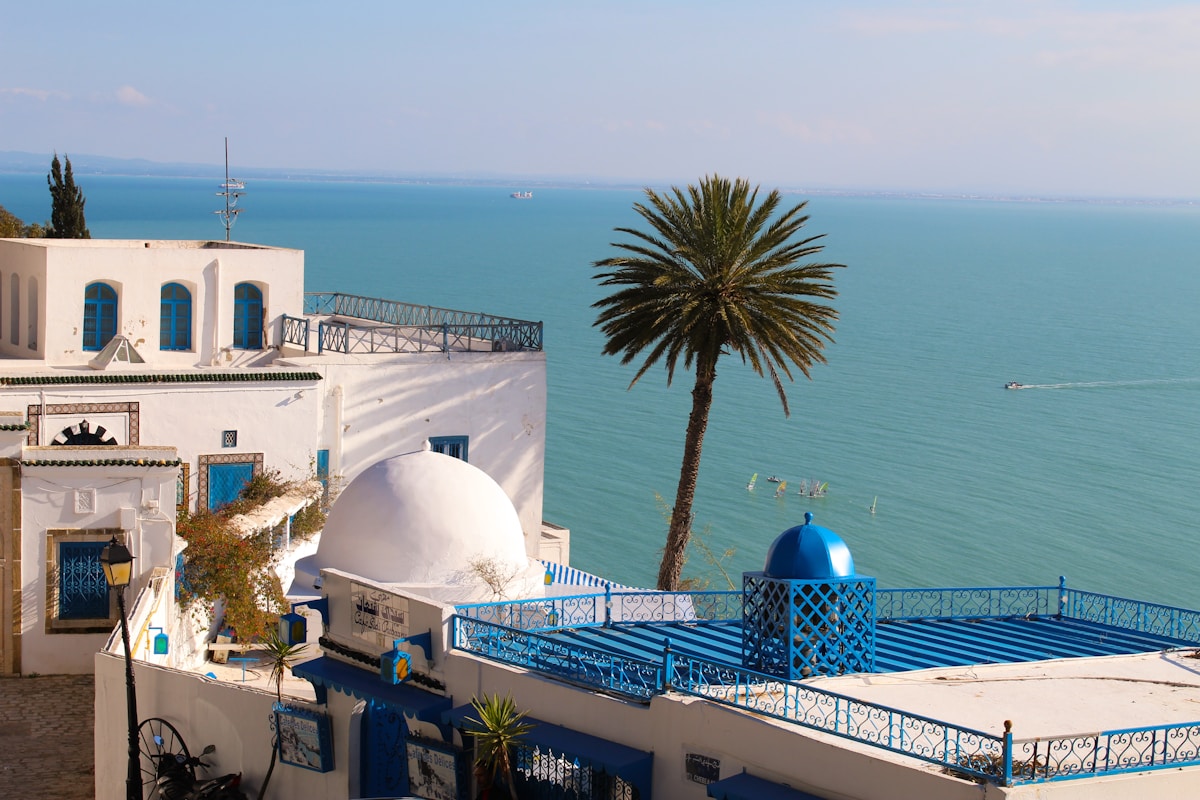
Djerba is Tunisia’s largest island and one of its most rewarding destinations, sitting in the Gulf of Gabès off the southern coast. It combines long sandy beaches with a genuinely distinctive cultural mix - Berber, Arab, Jewish, and Turkish influences layered over more than two thousand years of settlement. The easiest way to reach the island from Tunis is by flying directly to Djerba-Zarzis Airport (about 50 minutes) - you can compare fares and booking dates with Aviasales, which searches across multiple carriers on the route. From the mainland, a 7 km causeway (the Roman road, rebuilt many times since antiquity) connects the island to the town of Zarzis, and a car ferry runs from Jorf to Ajim on the island’s western tip every 30 minutes through the day.
Beaches
Djerba’s northeast coast holds the best beaches. Sidi Mahres is the main resort strip - a long, gently curving stretch of white sand running several kilometres east of the Zone Touristique, lined with resort hotels but never feeling overcrowded outside July and August. Seguia Beach, further east, is quieter and popular with kite surfers thanks to steady onshore winds. At the island’s far eastern tip, Ras R’mel is a low sandbar extending into the sea where greater flamingos gather in large numbers from autumn through spring - boat excursions run from Houmt Souk harbour to reach it.
On the south coast, the beaches near Aghir are calmer and less developed, which suits travellers who want something more low-key. The water across the island is shallow and warm, reaching 27-28°C in summer, and stays swimmable from May through October. For a full breakdown of the island’s beaches by atmosphere and access, see our Djerba beaches guide.
The Sidi Mahres strip supports the widest range of water activities on the island. Jet ski rental operates from kiosks along the resort frontage at approximately 120–150 TND for 30 minutes; pedalo boats and banana boat rides cost 20–40 TND. Several hotels along the Zone Touristique bundle watersports packages with accommodation. Windsurfing and kite surfing are better suited to Seguia Beach further east, where onshore winds are more consistent - schools operate from here in summer, hiring boards and offering lessons from approximately 80 TND per hour. The calm, shallow water makes Djerba particularly well-suited to children and less confident swimmers; the gentle tidal gradient on the northeast coast means the sea stays ankle-deep for 50–100 metres in many spots.
Getting to Djerba from Tunis
Flying is the fastest option. Direct flights from Tunis-Carthage Airport (TUN) to Djerba-Zarzis Airport (DJE) take around 50 minutes. Tunisair and Nouvelair operate the route regularly; return fares typically run 120–180 TND booked in advance, rising to 250 TND or more in peak summer. You can search live fares with Aviasales.
By land, the main bus companies (SNTRI, Soretras) connect Tunis to Djerba in around 6–7 hours with stops at Sfax and Gabès. A shared louage from Tunis or Sfax to Jorf (the mainland ferry terminal) is the faster overland option.
The Jorf–Ajim car ferry is the most practical route if you’re driving or arriving from southern Tunisia. The crossing takes around 15 minutes and runs continuously during daylight hours, roughly every 30 minutes. Passenger fares are approximately 1–2 TND per person; a vehicle with driver costs around 8–12 TND. The Jorf terminal is about 2.5 hours from Sfax and 30 minutes from Gabès. A second ferry route runs from Sfax to Sidi Youssef on the island’s northeast, but it operates less frequently and is mainly used for freight. For travellers coming from Sfax, the louage to Jorf followed by the short crossing is the most reliable connection.
Houmt Souk
Houmt Souk is the island’s main town and the place that gives Djerba its cultural weight. The medina is compact and walkable, centred on a network of covered souks selling ceramics, leather, silver jewellery, and woven textiles. The fondouks (old caravansaries) are worth seeking out - Fondouk el-Ghezaz and the surrounding lanes have been repurposed into craft workshops and guesthouses, with the original arched courtyards still intact.
The fish market at the harbour operates every morning and is one of the more atmospheric markets in southern Tunisia. Borj El K’bir, the 15th-century Ottoman fortress on the harbour front, houses a small museum and gives views across the port. Entry is around 7 TND.
Restaurants in Houmt Souk
Dining options in the medina range from hole-in-the-wall grills to proper sit-down restaurants. Restaurant Erriadh on Rue Mohamed Ferjani is a long-running favourite - reliable couscous, fish dishes, and brick à l’oeuf in a simple courtyard setting, mains around 15–25 TND. Restaurant Les Palmiers near the central square does grilled fish and seafood plates for around 20–30 TND. For something more casual, the market-side stands sell fricassée (fried bread stuffed with tuna, harissa, and olives) for 2–3 TND - one of the island’s best cheap meals. In the evening, the strip around Place Hédi Chaker has several café-restaurants where locals eat: expect to pay 15–20 TND for a main course with bread and salad. Most restaurants in Houmt Souk are cash-only; prices are generally lower than Tunis for equivalent quality.
Shopping in the Souk
The covered souk is divided into specialist sections: the fabric and clothing lanes run along Rue Moncef Bey; silver jewellery - primarily Berber-influenced pieces including fibula brooches, hand-of-Fatima pendants, and heavy silver ankle cuffs - clusters in the alleys around Place Hedi Chaker; ceramics sellers concentrate at the eastern medina entrance near the bus station. Bargaining is standard for jewellery and textiles - expect to start at roughly 60–70 per cent of the opening price and settle somewhere around 75–80 per cent. Fixed-price quality pottery can also be found at Guellala Heritage workshops, where prices are set and slightly higher but the craftsmanship is more consistent. Traditional embroidered tablecloths and jellabas are among the better-value souvenirs in the island’s fabric section. The Friday morning market at Midoun (around 15 km from Houmt Souk) is larger and less tourist-oriented, with fresh produce, livestock, and household goods alongside craft items - worth the short drive if you’re on the island mid-week through weekend.
El-Ghriba Synagogue
El-Ghriba, in the village of Hara Sghira about 6 km south of Houmt Souk, is one of the oldest synagogues in the world - local tradition dates it to the 6th century BCE, built by Jewish priests fleeing the destruction of Solomon’s Temple in Jerusalem. The current building is more recent (19th century), with blue-tiled walls and a richly decorated interior of carved wood and coloured glass. It remains an active place of worship and is the focal point of an annual pilgrimage during the Jewish festival of Lag Ba’omer (usually May), when thousands of visitors from across North Africa and Europe gather for several days of processions and prayer. Non-Jewish visitors are welcome outside prayer times; women should cover shoulders and knees, and shoes are removed at the door.
Erriadh and Djerbahood
The village of Erriadh, adjacent to El-Ghriba, was transformed in 2014 by the Djerbahood project, which invited around 150 street artists from 30 countries to paint murals across the village walls. The result is an open-air gallery scattered through residential lanes - some works are large-scale building facades, others are tucked into doorways and side alleys. The art has weathered and some pieces have faded, but new works have been added over time. Walking the village takes one to two hours and combines well with an El-Ghriba visit.
Guellala and Midoun
Guellala, on the island’s south coast, has been a pottery-producing village for centuries. Workshops are open to visitors and the clay pieces - amphorae, bowls, olive oil jars - are still produced using traditional wood-fired kilns. The Guellala Heritage Museum on the hillside above town covers Djerban daily life, wedding traditions, and the island’s craft history (entry around 5 TND).
Midoun, the island’s second-largest town, holds a Friday market that draws locals from across the island for produce, spices, clothing, and household goods. It is more of a working market than a tourist-oriented souk, which gives it a different energy. The town also has a small heritage quarter with traditional houch (courtyard houses) that have been partially restored.
Djerba Explore Park and Crocodile Farm
Djerba Explore, on the northeast coast near the Zone Touristique, is the island’s most-visited paid attraction. It contains three distinct sections: a heritage museum (Lalla Hadria Museum) covering Tunisian and Islamic art and craftsmanship; a reconstructed traditional village showing how Djerban life looked before mass tourism; and the crocodile farm, which holds over 400 Nile crocodiles at various stages of growth. The crocodile enclosures are the main draw for families - feeding times attract the largest crowds.
Entry to the full park (all three sections) costs approximately 25 TND for adults and 15 TND for children as of 2026; the crocodile farm alone can be visited for around 15 TND. Opening hours are roughly 9am–6pm daily, with reduced hours in winter. The site is well signposted from the main coastal road (Route de Midoun), about 8 km from Houmt Souk centre. Most resort hotels run excursions here; alternatively, a taxi from the Zone Touristique costs 5–8 TND one way.
Things to do
For a full guide to activities across the island - Houmt Souk market, El-Ghriba synagogue, pottery villages, and the best excursions - see our things to do in Djerba guide. If you’d prefer an organised day tour covering the highlights with transport included, our Djerba tours guide covers the best options.
Where to stay
Djerba has three distinct accommodation zones, each with a different character and price point.
Luxury - Zone Touristique (250–400 TND/night peak): The resort strip along Sidi Mahres beach is where most large-scale all-inclusive hotels cluster. Radisson Blu Djerba and Hasdrubal Prestige are the two most reliably managed international properties, both offering private beach access, multiple pools, and spas. Djerba Plaza Thalasso & Spa is a strong alternative with a dedicated thalassotherapy centre. Rates at 4-star all-inclusive resorts run 250–400 TND per night in July–August peak, falling to 150–220 TND in shoulder season (April–May and September–October).
Mid-range - Houmt Souk boutique (100–200 TND/night): Dar Dhiafa is a converted fondouk with a courtyard pool, elegant rooms, and an excellent in-house restaurant - among the most atmospheric stays on the island, typically 150–200 TND per night. Hotel Erriadh is a smaller, more modest boutique option in the medina, rooms from around 100–140 TND; less polished than Dar Dhiafa but better positioned for walking the souk. Fondouk el-Ghezaz nearby has been converted into a small guesthouse as well, with a handful of rooms in the original arched structure.
Budget - Houmt Souk centre (60–100 TND/night): Several locally run hotels in Houmt Souk town cater primarily to Tunisian and regional travellers. Hotel Arischa on Rue Mohamed Ferjani has basic but clean rooms from approximately 70–90 TND per night and is within five minutes’ walk of the harbour and main souk. Hotel Marhala, part of a Tunisian mid-range chain, offers reliable if simple rooms from around 80–100 TND; consistent standards and a central position. For budget travellers, staying in Houmt Souk rather than the Zone Touristique puts you inside the town at the cost of a taxi ride to the best beaches (8–12 TND).
Search all hotels in Djerba on Booking.com
For a full comparison of zones, properties, and what each area suits, see our where to stay in Djerba guide.
Seasonal timing, jellyfish, and pricing
April to June and September to October are the best months - warm enough for the beach, uncrowded, and with the best hotel rates. July and August bring European package tourists and higher prices.
Jellyfish warning: Djerba’s Gulf of Gabès waters experience jellyfish blooms in summer, typically from late June through August, with peak density in July and early August. The most common species are Pelagia noctiluca (mauve stinger) and Rhizostoma pulmo (barrel jellyfish). Blooms vary significantly year to year - some summers pass with few sightings, others bring heavy concentrations along the northeast beaches. Local beach staff at resort hotels usually post daily jellyfish alerts and provide vinegar for stings. If swimming during this period, check conditions with hotel staff before entering the water and avoid swimming at dawn and dusk when blooms surface most.
Winter (December to February) is mild (15–18°C days) and very quiet; many resort hotels close or operate at reduced capacity, but Houmt Souk stays open and the island has a pleasant off-season stillness. Flamingo viewing at Ras R’mel is best from October through March.
| Period | Beach weather | Crowds | Approximate hotel rates |
|---|---|---|---|
| Apr–May | 22–26°C, swimmable from May | Low | 120–180 TND/night (4-star) |
| Jun | 28–30°C, good | Medium | 150–220 TND/night |
| Jul–Aug | 32–35°C, hot | High, jellyfish risk | 250–400 TND/night |
| Sep–Oct | 26–30°C, excellent | Low-medium | 130–200 TND/night |
| Nov–Mar | 15–20°C, off-season | Very low | 80–140 TND/night |
Rates are approximate as of 2026 for mid-range 4-star all-inclusive resorts; boutique guesthouses in Houmt Souk typically run 80–150 TND year-round.
Getting around Djerba
The island covers about 514 km² - compact enough to navigate in a day, but spread out enough that walking between main sites is not practical. The Zone Touristique on the northeast coast, Houmt Souk, Erriadh, and Guellala are 10–20 km apart.
Rental car or scooter: The most flexible option. Car rental agencies operate at Djerba-Zarzis Airport and in Houmt Souk centre; rates run approximately 80–130 TND per day for a basic manual car. Scooter and motorbike rental is available in Houmt Souk for around 50–70 TND per day and is a popular choice for the island’s flat roads. A valid licence is required. Roads on Djerba are generally quiet outside July and August, and the island has good paved roads connecting all main sites.
Taxis: Yellow taxis run between the Zone Touristique, Houmt Souk, and other main points on the island. Fares are metered for short journeys; a trip from the Zone Touristique to Houmt Souk costs around 8–12 TND. For longer excursions - a circuit taking in Guellala, Erriadh, and Midoun - negotiate a fixed price before departing; a half-day circuit by taxi typically costs 40–60 TND.
Organised tours: The most convenient option for first-time visitors. Most Zone Touristique resort hotels offer daily excursion buses covering the main island circuit (El-Ghriba, Erriadh, Guellala, Houmt Souk harbour) for 30–50 TND per person. A private Djerba tour gives more flexibility on timing and pace.
Local buses: Infrequent public buses run between Houmt Souk and the main towns, but schedules are unreliable for sightseeing. Not recommended as the primary way to get around.
Day trips from Djerba
Zarzis (40 km, 40 minutes by car): The nearest mainland town via the causeway, Zarzis has some quieter beaches and a working olive oil trade that gives it a less tourist-oriented atmosphere than the island. Not a major attraction in itself, but worth knowing if you want an afternoon off the island. Shared louages from Houmt Souk bus station run to Zarzis for around 6–8 TND per person.
Gabès (90 km, 90 minutes): A working port city with a rare urban oasis - date palms and olive groves growing within metres of the Gulf of Gabès shoreline. The oasis walk through Chenini district takes 2–3 hours and passes pottery workshops, small herb gardens, and the occasional camel. The waterfront is functional rather than beautiful, but the contrast with Djerba’s resort landscape is striking. Louages from Houmt Souk to Gabès cost approximately 10–14 TND per person.
Matmata (120 km, 2 hours): The Berber cave-dwelling village of Matmata is accessible as a long day trip from Djerba - two hours each way through Gabès and then up into the Jebel Dahar foothills. The troglodyte houses, built into the hillside with open-sky courtyards, are the main draw; the Hôtel Sidi Driss is a working hotel and the original Star Wars filming location for the Lars Homestead interior. If you’re making the journey, an overnight stay in Matmata is more satisfying than a rushed day trip. Alternatively, Matmata fits naturally into a multi-day Sahara tour from Tunis that continues to Tozeur and the desert.
Ksar Ouled Soltane (2.5 hours west): The most visually dramatic of the southern ksour (Berber fortified granaries), with ghorfas (storage cells) stacked four storeys high around two courtyard spaces. Remarkably well preserved and far less visited than the more famous examples near Tataouine. Hire a car or arrange a private taxi for the day (approximately 150–200 TND for a full day circuit) - there is no practical public transport.
How Djerba fits into a wider trip
Djerba works well at the end of a southern Tunisia circuit. From Douz or Matmata, the drive to the Jorf ferry terminal takes roughly two to three hours. The ferry crossing to Ajim is about 15 minutes and costs a few dinars per car. Alternatively, Djerba makes a standalone beach destination for travellers flying directly from Europe - several charter routes serve the island in summer.
If you’re weighing up Djerba against other Tunisian beach destinations, see our Djerba vs Monastir comparison or the broader Hammamet vs Djerba vs Sousse guide. A guided island tour is worth considering for the first day - it covers Houmt Souk, El-Ghriba, Erriadh, and Guellala in a single loop with transport sorted. Three to four nights is enough to cover the beaches, the main cultural sites, and at least one village excursion. A full week is not too long if relaxation is the priority.
Plan Your Trip
✈️ Book your flights to Tunisia 🛡️ Get travel insurance 📱 Stay connected with an eSIM 🚗 Rent a car