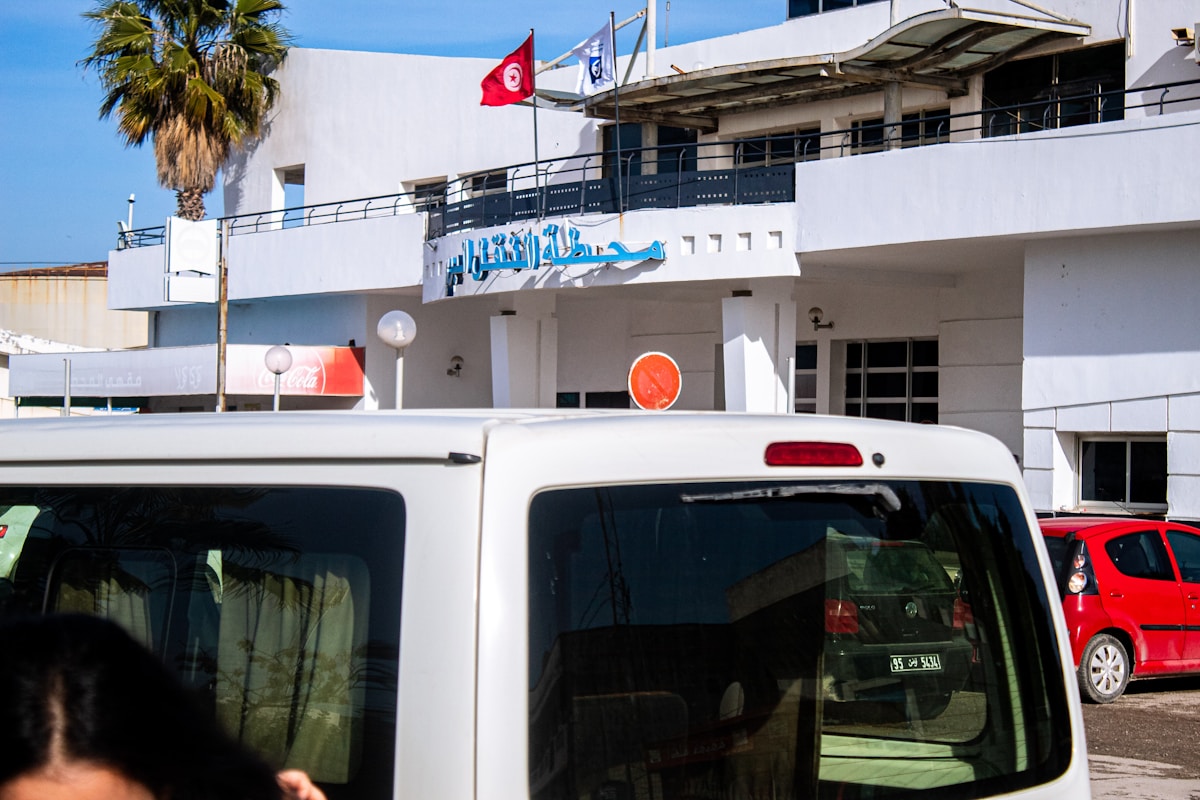
The louage is one of the most practical ways to travel around Tunisia. It is a shared minibus taxi running fixed intercity routes, carrying around seven to nine passengers, and departing only when the vehicle is full. There is no timetable and no advance booking - you turn up, take your seat, pay a fixed fare, and wait for the vehicle to fill. For most intercity journeys, louages are faster than buses and far cheaper than private taxis.
Once you understand how the system works, it becomes one of the easiest and most efficient ways to cross the country.
How the louage system works
Each louage follows a specific route between two towns or cities. The vehicle - usually a minibus with distinctive coloured stripes - waits at a designated station or depot until every seat is sold. Long-distance louages typically have red stripes; local and regional ones may have yellow or blue markings.
At the station, you either buy a ticket at a booth or pay the driver directly. Signs at some depots show destinations and prices clearly; at smaller or older stations you may need to ask. A few words of French or Arabic go a long way, and station staff or fellow passengers are generally willing to point you in the right direction.
The main variable is waiting time. On popular routes, the louage fills in minutes. On quieter routes, you may wait up to an hour. Travelling earlier in the day gives you more options and shorter waits on most routes.
Louage stations in Tunis
Tunis is the main hub of the louage network, and it has several stations rather than one central terminal. Knowing which one to use for your destination saves a lot of wasted time.
| Station | Destinations served |
|---|---|
| Bab Saadoun | Bizerte, Jendouba, Tabarka, northwest routes |
| Moncef Bey | Sousse, Monastir, Kairouan, El Jem, Sfax, Gabès, south and central |
| Bab Alioua | Nabeul, Hammamet, Kelibia, Zaghouan, Cap Bon peninsula |
If you are heading south toward Sousse or Kairouan and you accidentally arrive at Bab Alioua, you will need to backtrack. Confirming your station before leaving your accommodation is a simple way to avoid this.
Search hotels in Tunisia on Booking.com
Key routes and typical fares
Louage fares are fixed and significantly cheaper than private taxis on the same routes. Prices occasionally shift with fuel costs, but the ranges below reflect what most travellers pay.
| Route | Typical fare | Journey time |
|---|---|---|
| Tunis → Hammamet | 7–9 TND | ~1h |
| Tunis → Nabeul | 8–10 TND | ~1h15 |
| Tunis → Sousse | 12–13 TND | ~1h30 |
| Tunis → Kairouan | 14–16 TND | ~2h |
| Tunis → Tabarka | 15 TND | ~2h30 |
| Tunis → Sfax | 18–22 TND | ~3h30 |
| Tunis → Gabès | 22–26 TND | ~3h30–4h |
| Kairouan → Sfax | 16 TND | ~2h |
| Kairouan → Hammamet | 13 TND | ~1h30 |
| Sfax → El Jem | 6–7 TND | ~40 min |
| Sfax → Gabès | 10–12 TND | ~1h30 |
| Gabès → Djerba (via ferry) | 10–14 TND | ~1h15–1h30 |
| Gabès → Matmata | 5–7 TND | ~45 min |
| El Hamma → Gabès | 3 TND | ~20 min |
As a rough guide: short hops are a few dinars, medium intercity trips (one to two hours) sit between 10 and 16 TND, and longer journeys to the far south can reach the low twenties. Always carry cash in small denominations - louages are entirely cash-based.
Key routes and dedicated guides
For each major route, we have written a detailed guide with station details, exact fares, journey times, and practical tips:
- Louage Tunis–Sousse — 12–13 TND, approximately 1h30, depart Moncef Bey
- Louage Tunis–Sfax — 18–22 TND, approximately 3h30, depart Moncef Bey
- Louage Tunis–Djerba — two legs via Gabès, 32–40 TND combined
- Louage Tunis–Nabeul — 8–10 TND, approximately 1h15, depart Bab Alioua
- Louage Sousse–Monastir — 4–6 TND, approximately 30–40 min
Louage Tunis to Sfax {#louage-tunis-sfax}
Departure station: Moncef Bey (south terminal), Tunis Fare: 18–22 TND per seat Journey time: approximately 3h30
The Tunis–Sfax route runs directly without requiring a connection. Louages depart from Moncef Bey and head south along the main coastal corridor, passing through or near Sousse and El Jem. This is one of the busiest long-haul routes in the network, so vehicles fill steadily through the morning. Travelling before 9am reduces waiting time noticeably. In Sfax, the louage station sits west of the railway station and is accessible by taxi from the medina. Sfax is also the main transfer hub for El Jem, Gabès, and the far south.
If you need to be in Sfax at a specific time — for a ferry to the Kerkennah Islands or a business appointment — a private transfer in Tunisia removes the uncertainty of waiting for the vehicle to fill.
→ Read the full guide: Louage Tunis–Sfax
Louage Tunis to Djerba {#louage-tunis-djerba}
Route: Tunis → Gabès → Djerba (ferry crossing at Jorf–Ajim) Combined fare: approximately 32–40 TND (Tunis–Gabès 22–26 TND + Gabès–Djerba 10–14 TND) Total journey time: approximately 5h30–6h
There is no direct louage from Tunis to Djerba. The standard route is a louage from Moncef Bey to Gabès (around 3h30–4h, 22–26 TND), then a second louage from Gabès to Djerba (1h15–1h30, 10–14 TND). The Gabès–Djerba leg crosses on a short car ferry between Jorf and Ajim — the crossing takes around 15 minutes and is free for foot passengers. Add short taxi transfers at each end and the full journey from central Tunis to Houmt Souk is around 5.5–6 hours.
An alternative route via Sfax (Tunis → Sfax → Gabès → Djerba) adds a connection but can be quicker if the Moncef Bey–Gabès service is slow to fill. If you are arriving at Djerba–Zarzis Airport, booking an airport transfer is far simpler — louages do not serve the airport directly.
→ Read the full guide: Louage Tunis–Djerba
Louage Tunis to Hammamet {#louage-tunis-hammamet}
Departure station: Bab Alioua, Tunis Fare: 7–9 TND per seat Journey time: approximately 1h–1h15
This is one of the quickest and most straightforward louage routes from the capital. Louages depart from Bab Alioua (the Cap Bon terminal) directly to Hammamet’s louage and bus station on the edge of town. Services run frequently through the morning and early afternoon. For Nabeul, the same station applies with a similar fare (8–10 TND). If you are staying in Yasmine Hammamet rather than the old town, allow around 5 TND for a local taxi from Hammamet station to your hotel. Note: Bab Alioua is the wrong station for Sousse or Kairouan — those routes leave from Moncef Bey.
Gabès: the southern gateway {#louage-gabes}
Gabès is the essential junction for travel to the far south. Nearly every deep-south route passes through it, and most travellers heading to Djerba, Matmata, or Tataouine will connect here. The station is centrally located near the Habib Bourguiba avenue.
Key connections from Gabès:
| To | Fare | Time |
|---|---|---|
| Djerba (via ferry) | 10–14 TND | 1h15–1h30 |
| Matmata | 5–7 TND | ~45 min |
| Tataouine | 10–14 TND | ~1h15 |
| Sfax (northbound) | 10–12 TND | ~1h30 |
| Tunis (northbound) | 22–26 TND | ~3h30–4h |
If you arrive in Gabès by louage from Tunis and need to continue south the same day, aim to arrive before noon — onward services thin out in the afternoon, particularly toward Matmata. The Jorf–Ajim ferry runs frequently through the day, so the Djerba connection is generally reliable until mid-afternoon.
Prefer a private transfer? {#private-transfer-tunisia}
Louages are excellent value but run on their own schedule — they leave when full, not at a fixed time. If you have a flight to catch, a hotel check-in at a set time, or luggage that makes the compact seats impractical, a private transfer is worth the extra cost. Private transfers in Tunisia cover airport pickups, intercity runs, and resort connections across the country. Welcome Pickups offer English-speaking drivers with upfront pricing, particularly useful for the Tunis–Carthage, Enfidha–Hammamet, and Djerba–Zarzis airport routes.
Regional hubs to know
Sousse and Monastir - Sousse is one of the most important transfer points in the network, connecting Tunis with Kairouan, Monastir, Sfax, and points further south. The louage station sits outside the medina, so add a short taxi ride if you are staying centrally. Monastir’s station is closer to the city centre and straightforward to reach. See the Louage Tunis–Sousse guide and Louage Sousse–Monastir guide.
Sfax - One of the largest louage centres in Tunisia, Sfax is the key junction for southern travel. From here you can connect to El Jem, Gabès, and onward toward Tataouine and the desert interior. The station is typically west of the railway station.
Kairouan - Well positioned and relatively easy to navigate, Kairouan’s louage station connects the city with Tunis, Sousse, Hammamet, and Sfax. It is a natural stop for travellers combining coastal and inland destinations.
Gabès and Djerba - Gabès functions as the main gateway between the coast and the south, linking routes to Djerba, Tataouine, Tozeur, and Matmata. On Djerba, the main louage departures are from Houmt Souk. Many southbound journeys work best as a chain of connections rather than a single direct route.
Louage vs bus vs train
| Louage | Bus (SNTRI) | Train (SNCFT) | |
|---|---|---|---|
| Booking | No booking needed | Can book in advance | Advance booking available |
| Departure | Leaves when full | Fixed timetable | Fixed timetable |
| Speed | Fast - fewer stops | Slower, more stops | Moderate |
| Cost | Low, fixed fare | Low | Low to moderate |
| Availability | Very wide coverage | Main cities and routes | Limited network |
| Comfort | Compact, functional | Varies | Generally comfortable |
| Luggage | Limited space | More room | More room |
Louages win on speed and flexibility for most intercity journeys. Trains are more comfortable for longer trips where they exist (Tunis–Sousse–Sfax is the main line). Buses are useful for overnight journeys and for routes where louage coverage is thin.
Practical tips
Carry cash. Louages do not accept cards and there is no online booking. Have small-denomination notes ready to pay on boarding.
Know the French or Arabic name of your destination. Station signs and drivers may not use the English spelling. Sfax and Gabès are the same in French; Kairouan, Nabeul, and Bizerte are close enough. For smaller towns, look up the Arabic name before you travel.
Travel in the morning. Louages are most frequent in the first half of the day. Afternoon services on less popular routes can be patchy, and on some routes the last vehicle of the day departs earlier than you might expect.
Plan connections for the south. Not every southern destination has a direct louage from Tunis or Sousse. Expect to connect in Sfax, Gabès, or Kairouan for routes toward Tataouine, Douz, or Tozeur. This is normal - the network is designed around regional hubs.
Confirm the destination before boarding. Stations can feel busy and informal. Asking a station worker or fellow passenger to confirm you are in the right vehicle takes ten seconds and avoids ending up on the wrong route.
Why louages are worth using
Louages make it possible to travel around Tunisia independently without renting a car. They connect major cities, secondary towns, and regional hubs at low cost, often with faster journey times than scheduled buses. They are also the most practical option for reaching places like El Jem or Kairouan as a day trip from Sousse or Tunis. If you prefer a guided itinerary, day tours from Tunis cover the main sites with transport included.
For visitors who want to move around the country on their own terms and at a reasonable pace, understanding the louage network is one of the most useful things they can do before they arrive. If you decide that more flexibility is worth the extra cost - particularly for the south, where connections can involve multiple changes - hiring a car is the most practical alternative. For a broader overview that includes car hire, airport transfers, and trains, see our full guide to getting around Tunisia.
Plan Your Trip
✈️ Book your flights to Tunisia 🛡️ Get travel insurance 📱 Stay connected with an eSIM 🚗 Rent a car