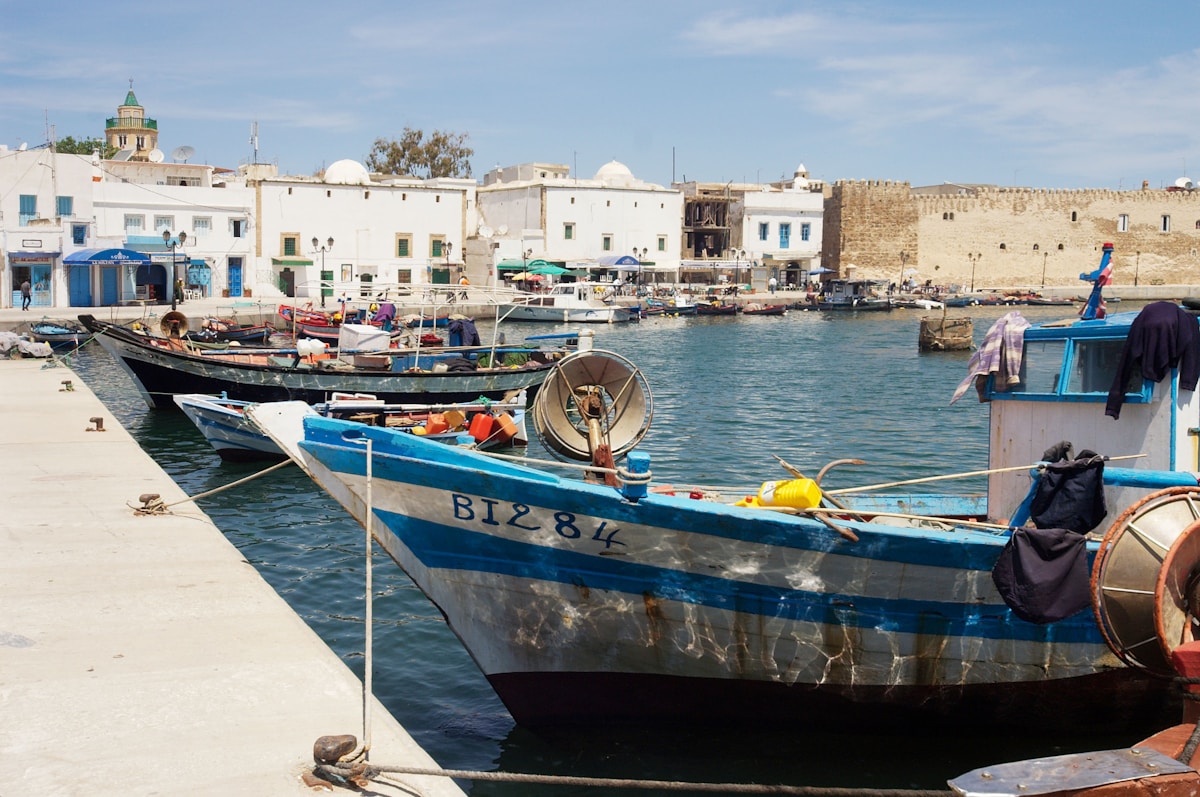
Bizerte sits on the northern tip of Tunisia, 65 kilometres from Tunis, and carries the distinction of being the northernmost city on the African continent. It is a working town - a naval base, a fishing port, and a commercial centre for the surrounding agricultural region - and it has the texture of a place that has never been restructured for tourism.
The old port is the heart of the city for visitors: a rectangle of calm water lined with small fishing boats, French colonial buildings in faded ochre and white, and a cluster of cafes where the main business of the morning is strong coffee and small talk. Behind the port, the kasbah and old medina occupy a compact hillside. North of the city, the coast opens into some of the cleanest and least developed beaches in northern Tunisia.
The Vieux Port
The old port (vieux port) of Bizerte is one of the most photogenic harbour scenes in Tunisia. The basin is small enough that you can take it in from almost any point along the quay - fishing boats in blue and white, the kasbah walls rising behind them, and the minaret of the Sidi el-Hani mosque visible above the roofline.
The port is working in the most literal sense: fishermen bring catches in early morning, boats are repaired on the quay, and nets are laid out to dry along the waterfront. The fish market near the port entrance opens in the early morning and sells the previous night’s catch - tuna, sea bass, octopus, and the small local mullet that end up in many of the restaurants nearby.
The corniche road runs along the canal between the Mediterranean and Lac de Bizerte, and the canal itself - used by naval and commercial shipping - gives the city an unusual geography you don’t find anywhere else in Tunisia.
The Kasbah and Medina
Bizerte’s kasbah sits above the old port, reached by a short climb from the waterfront. The fortification dates to the Byzantine period, was modified by Arabs after the 7th century conquest, and continued to be built upon through the Ottoman period. The views from the kasbah walls over the port and the sea are the best in the city.
The small medina behind the kasbah is less developed than the medinas of Tunis, Sousse, or Sfax - it has a neighbourhood feel rather than a souk economy, with residents going about daily business and few organised shops aimed at visitors. The Great Mosque of Bizerte (Jami el-Kebir) dates from the Hafsid period and is one of the more quietly impressive mosques in northern Tunisia.
The Musée Océanographique de Bizerte, near the port entrance, covers the marine ecology of the Lake of Bizerte and the Gulf of Tunis. It is small but informative, and entry costs approximately 4 TND as of 2026 (hours vary; check locally on arrival).
The Beaches North of Bizerte
The coastline north and east of Bizerte is where most visitors head for a full day. The main beach areas are:
Remel Beach (about 10 kilometres east of the city centre): A long sandy beach with calm water, popular with Tunisian families in summer. Beach clubs here rent umbrellas and sun loungers for approximately 5–10 TND per day.
Ras Angela (about 20 kilometres north): Rockier coastline with crystal-clear water in several small coves. The swimming here is excellent when the sea is calm. Access requires a car or taxi from Bizerte.
Cap Angela and Cap Blanc (around 30 kilometres north): This is the northernmost land in Africa - a low headland of scrub and limestone above the Mediterranean. There is almost no infrastructure, which is part of the point. The drive through the undeveloped northern hinterland is itself worth doing.
A taxi from central Bizerte to Remel beach costs approximately 8–12 TND. To reach Cap Blanc, a hire car gives far more flexibility.
Getting to Bizerte
By car from Tunis: The A4 motorway connects Tunis to Bizerte in approximately 1 hour. This is the most practical option if you want to continue north to the beaches.
By bus: SNTRI buses from Tunis Bab Saadoun terminal run several times daily. Journey time is around 1.5 hours; fares approximately 6–8 TND as of 2026. The bus station in Bizerte is on Avenue Habib Bourguiba.
By louage: Shared taxis from Tunis Bab Saadoun to Bizerte take around 1 hour and cost approximately 8–10 TND per seat. The louage station in Bizerte is near the bus terminal.
Where to Stay in Bizerte
Hôtel Corniche Palace (Route de la Corniche) overlooks the canal approach and has a good position for both the old port and the north coast beaches. Rooms from approximately 150–220 TND per night as of 2026.
Search hotels in Bizerte on Booking.com
Hôtel Nador (near the vieux port) is a simpler option in a very central location with clean rooms from approximately 80–120 TND per night.
For travellers with a car who want beach access, smaller riads and guesthouses around the Remel area exist but are sparse - most beach visitors commute from the city centre.
Where to Eat in Bizerte
Bizerte’s port position makes it one of the best cities in Tunisia for fish.
Restaurant Eden (near the vieux port) is consistently well-regarded for fresh fish and seafood - grilled or baked, with a selection of Tunisian mezze to start. A full meal costs approximately 25–40 TND per person as of 2026.
Restaurant Le Sport Nautique (on the corniche, near the old fort) serves fish and pasta dishes in a canal-view setting. Expect to pay approximately 20–35 TND per person.
Street food around the port includes merguez sandwiches, brik (egg pastry), and sesame cookies - a few dinars each.
Bizerte as a Day Trip from Tunis
Bizerte is close enough to Tunis - 65 kilometres on a good motorway - to function as a half-day or full-day excursion. The old port and kasbah can be seen in a morning; a full day allows for lunch in the city and an afternoon at Remel or Ras Angela beach.
This is a genuinely worthwhile day out from Tunis that reaches a different register of Tunisian life from Carthage and Sidi Bou Said, while still being highly accessible. For those building a wider northern Tunisia route, Bizerte pairs well with a visit to Tabarka on the northwest coast. A day trip from Tunis can include Bizerte alongside other nearby highlights — or book a guided day trip from Tunis covering Utica, Bizerte, and Ichkeul Park. For the full range of tours and activities in Bizerte, GetYourGuide lists current options. Make sure you have travel insurance for Tunisia before you travel.
Plan Your Trip
✈️ Book your flights to Tunisia 🛡️ Get travel insurance 📱 Stay connected with an eSIM 🚗 Rent a car