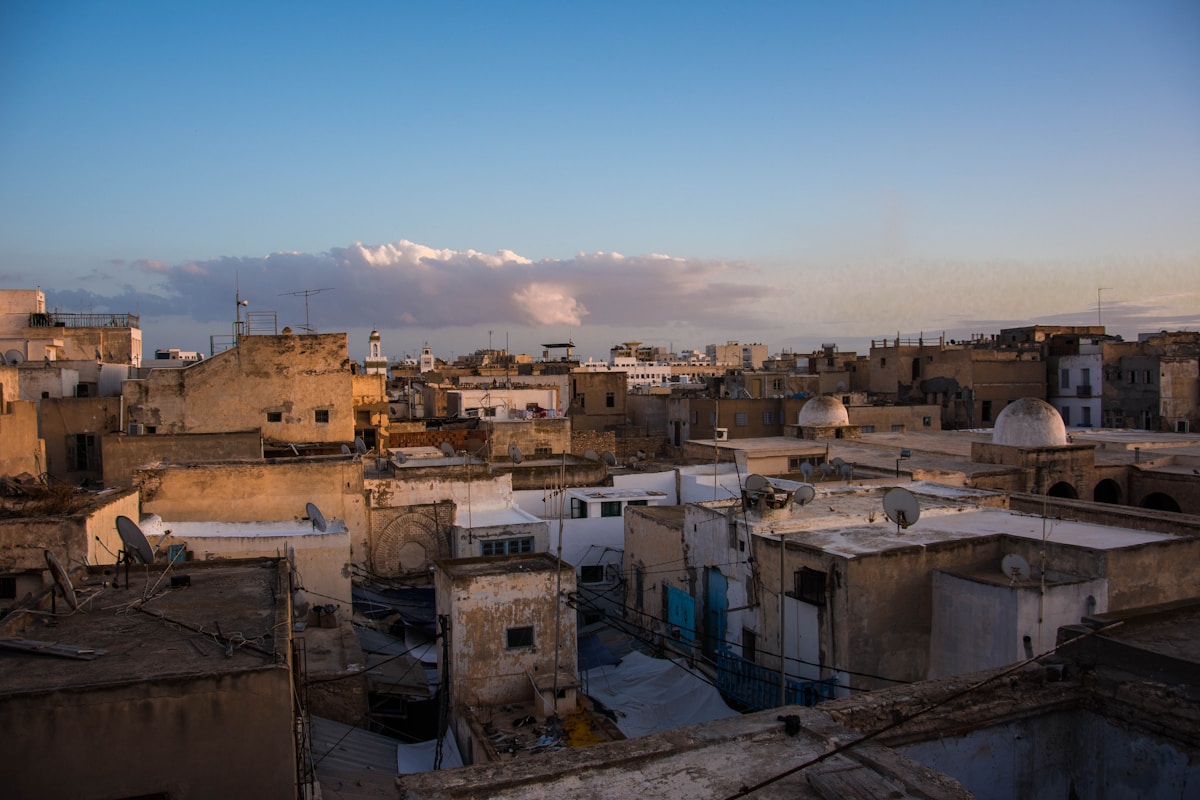
The louage from Tunis to Sfax covers roughly 270 kilometres in around 3 hours 30 minutes, making it the standard long-haul louage route in Tunisia. Sfax is the country’s second city and one of the main hubs for southern travel — from Sfax you can continue to El Jem, the Kerkennah Islands, Gabes, and beyond. The louage is the cheapest and often fastest way to get there from the capital.
The right station: Moncef Bey
All long-distance southbound louages from Tunis depart from Moncef Bey station, the city’s southern terminal. It sits around 4 kilometres south of the medina and is most easily reached by taxi (5-8 TND from central Tunis) or by connecting metro line. Allow at least 30 minutes to reach the station from a central hotel.
The station handles multiple routes simultaneously — Sousse, Kairouan, Sfax, Gabes, and others all depart from different bays. On arrival, look for signs to Sfax or ask a station worker to point you to the right vehicle. French is the working language at the station; “Sfax” is understood without further explanation.
Fares and payment
The standard fare from Tunis to Sfax is 18-22 TND per seat as of 2026. Cash only. Have small notes ready — drivers rarely carry change for large bills. Some stations display a price board; if not, confirm the fare before boarding by asking at the booth or checking what other passengers are paying.
There is no advance booking system. You pay and board on the day.
Timing the journey
The Tunis–Sfax louage is one of the busiest long-distance routes in the network, and vehicles fill regularly through the morning. The best time to travel is between 7am and 10am — vehicles fill quickly, wait times are short, and you arrive in Sfax before the afternoon heat peaks.
After midday, services thin out. You may wait 30-60 minutes for a vehicle to fill, and if you travel after 3pm you risk missing the last vehicle of the day. On this route, morning travel is not just more comfortable — it is more reliable.
If you are heading to Sfax for a morning ferry to the Kerkennah Islands (ferries typically depart around 7am and 1pm from the Sfax port), you may need to take an overnight bus rather than the louage. The ferry terminal is a short taxi ride from Sfax’s louage station.
The journey
The route follows the A1 motorway south from Tunis, passing through Hammamet and then along the coast toward Sousse and beyond. After Sousse, the motorway continues south to Sfax without significant stops. The total distance is around 270 kilometres.
Unlike shorter routes, the Tunis–Sfax louage can feel long in summer without air conditioning. Some vehicles are modern and air-conditioned; older models are not. If comfort matters, check the vehicle before taking your seat — you can often choose a newer vehicle by waiting for the next one to fill.
Arriving in Sfax
The louage drops you at or near Sfax’s louage station, which is located west of the railway station and accessible on foot from the medina. The city centre and the medina are within a 10-15 minute walk or a short taxi ride (3-5 TND).
From Sfax’s louage station, onward connections are available to:
| Destination | Fare | Time |
|---|---|---|
| El Jem | 6-7 TND | ~40 min |
| Gabes | 10-12 TND | ~1h30 |
| Tataouine | 22-26 TND | ~2h30 |
| Kerkennah ferry port | taxi, ~5 TND | ~15 min |
Sfax is one of the most important louage junctions in Tunisia for southbound travel. If you are heading to the far south — Tataouine, Douz, the Sahara — Sfax is a natural and efficient place to change vehicles.
Search hotels in Sfax on Booking.com
Tips for foreign travellers
Go early. The Tunis–Sfax route is long enough that an early start gives you the full afternoon in Sfax rather than arriving in the early evening.
Bring water and snacks. At 3h30, this is one of the longer direct routes in the network. There are no comfort stops, and the louage does not stop at petrol stations or cafes en route.
Confirm the destination is Sfax-direct. Most Moncef Bey vehicles for Sfax go directly without changing at Sousse. If a driver suggests you change at Sousse, you can do so, but a direct vehicle is available and simpler.
Luggage. For a long journey, a roof rack or boot space is standard practice. Confirm there is space for larger bags before boarding.
Sfax is a business city. Unlike the beach destinations, Sfax is primarily a commercial and industrial hub. The old medina is worth a visit, but most travellers use Sfax as a transport junction for El Jem, Gabes, or the Kerkennah Islands rather than as a final destination.
Alternatives to the louage
Train: The SNCFT Tunis–Sfax intercity service runs several times daily, takes around 3 hours, and is air-conditioned on express services. Fares are slightly higher than the louage. Trains have fixed departure times and reserved seating — useful if you want predictability on a long journey.
Bus: SNTRI runs overnight buses on some routes. Slower than the louage but comfortable for overnight travel, freeing up a full day on either end.
Private transfer: For groups or travellers with tight schedules, a private transfer from Tunis to Sfax is a premium alternative with a fixed arrival time. See private transfers in Tunisia.
For the full route overview including connections to the south, see the louage guide for Tunisia.
Plan Your Trip
✈️ Book your flights to Tunisia 🛡️ Get travel insurance 📱 Stay connected with an eSIM 🚗 Rent a car