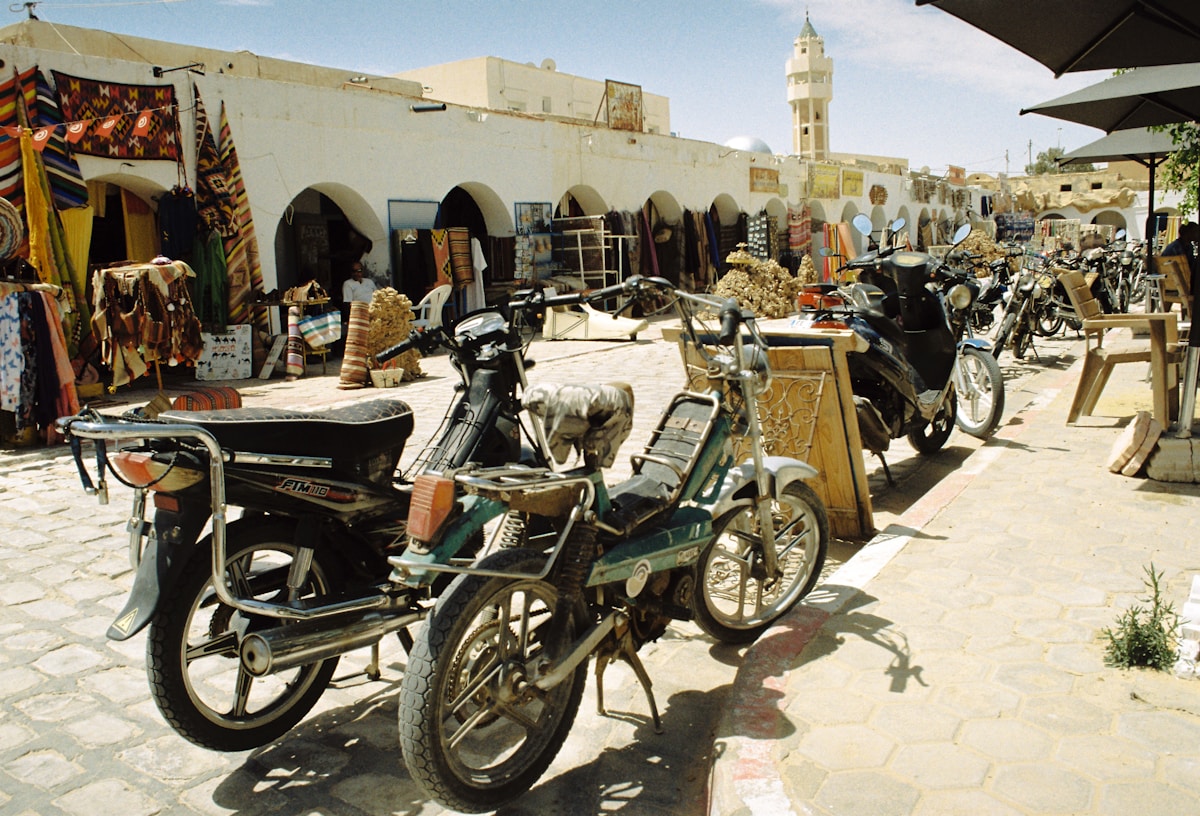
Tunisia is a genuinely rewarding destination, and the vast majority of visitors travel without serious incident. The risks that do exist are mostly specific and predictable: a handful of well-worn scam patterns in the medinas, overcharging on transport, and the kind of street-level pressure you find in any busy North African market. Understanding how these work in advance is almost all the preparation you need.
For a full breakdown of travel advisories and restricted zones, see our Tunisia safety overview. This guide focuses specifically on the everyday situations - scams, taxi tactics, beach risks, police interactions, and practical safety for women - that aren’t covered in depth elsewhere.
Medina scams: how they work and how to stop them
The medinas of Tunis, Sousse, Kairouan, and to a lesser extent Sfax and Djerba all attract the same cluster of scam patterns. Knowing the script makes them easy to deflect.
The unofficial guide attachment. A friendly local approaches near the medina entrance - often in good English or French - and offers to show you around. They present themselves as a local wanting to practise their language skills, or as someone who simply wants to help. Twenty minutes later, you’re deep in the souk, and a payment is expected. The fix: a confident, friendly “la shokran” (Arabic for “no thank you”) delivered without breaking stride. Don’t apologise, don’t explain - just keep walking. Most will disengage after one clear refusal.
The carpet shop diversion. A variant of the above, where the unofficial guide steers you into a cousin’s or friend’s carpet or ceramics shop. Once inside, high-pressure sales tactics follow. The easiest solution is not to enter. If you do enter, there is no obligation to buy. Taking photos of pieces and saying you’ll “think about it” is a legitimate exit.
The wrong route redirect. In the Tunis medina specifically, locals will sometimes approach visitors who look slightly lost and confidently direct them the wrong way - away from a free attraction and toward a paid shop or restaurant. Use Google Maps with downloaded offline maps, or verify your direction with the guesthouse or riad you’re staying in before heading out.
Search hotels in Tunisia on Booking.com
The “free” item. A trader presses a bracelet, an orange slice, or a small item into your hands and then demands payment. The answer is to hand it back immediately. Accepting and then refusing to pay creates a drawn-out confrontation. Not accepting makes the whole thing two seconds long.
Museum “helpers.” At some smaller sites, a man in ordinary clothes will attach himself and begin providing commentary. Unlike licensed guides, there is no official sign of authorisation. At major sites like the Bardo Museum and El Jem amphitheatre, official ticket desks and entrance processes make this harder. At smaller medina monuments, it’s more common. Ask to see credentials, or decline firmly at the start.
Taxi overcharging
Taxi scams are the most common form of tourist overcharging in Tunisia, and the most easily avoided.
In Tunis: Licensed yellow taxis have meters (compteurs). Always ask for the meter at the start of the journey: “bil-addad” in Tunisian dialect, or “le compteur” in French. A typical city centre journey costs 3–8 TND on the meter (as of 2026). Tunis-Carthage Airport to the city centre runs approximately 15–25 TND by meter, depending on traffic and exact destination. Night rates (after 9pm) are higher - roughly 50% more. Drivers switching the meter off, claiming it’s broken, or quoting a flat fare significantly above what the meter would show are all red flags.
Bolt ride-hailing operates in Tunis and is generally cheaper and more transparent than street taxis, with upfront pricing visible in the app. For airport pickups, pre-booked private transfers eliminate any ambiguity entirely and are worth the premium, particularly for late-night arrivals.
Outside Tunis: In Hammamet, Sousse, and Djerba, metered taxis exist but are less consistently used. Agreeing the price before getting in is standard practice. Asking locals or your accommodation for a rough guide to the going rate before you hail a cab is always sensible.
Louages (shared taxis): Louage fares are fixed and the same for tourists as for locals - overcharging is uncommon. For intercity travel, they’re typically a fairer option than private taxis.
Beach safety
Tunisia’s Mediterranean coast - Hammamet, Sousse, Djerba, Monastir - has generally supervised beaches at the main resort hotels. A few things to watch:
Rip currents: Not a major risk on the calm Gulf of Hammamet, but more relevant on the rougher northern coast near Tabarka. Look for flag systems at organised beaches. Red flags mean no swimming.
Beach vendor pressure: Vendors selling everything from henna tattoos to sunglasses circulate on public beaches. A simple “la, shokran” is enough - they move on quickly. Henna artists on some beaches can be persistent; setting a fixed price in advance if you’re interested prevents post-application price inflation.
Jet ski operators: Some jet ski operators on tourist beaches quote one price verbally and attempt to charge more when you return. Agree the price, duration, and deposit terms clearly before starting, and get a receipt if one is offered.
Unattended belongings: Leave valuables in hotel safes, not on the beach. Bag theft on crowded public beaches, while not epidemic, does occur. Locking your car at beach access points is important - opportunistic car break-ins happen at popular roadside beach spots.
Police checkpoints
Tunisia has a significant number of police and National Guard checkpoints, particularly on routes between cities and in areas near military sites or the southern desert gateways.
What to expect: You may be waved through without stopping, or the vehicle may be asked to pull over for a document check. Officers typically want to see passport, driving licence (if you’re driving), and vehicle documents. The process is usually brief - under two minutes - and routine.
For drivers:
- Carry your passport (or a clear photocopy), driving licence, and the hire car’s registration and insurance documents at all times.
- Obey the officer’s instructions calmly. Speed limits are enforced at some checkpoints - officers have radar equipment.
- Avoid photography near military or police installations at any point on your journey.
At airports and entry points:
- Tunisia uses an embarkation card system. Fill this in accurately - officers cross-reference at exit.
- If you’re asked to step aside for additional document checks, this is routine. Answer questions factually and calmly.
Tourists are very rarely held for any length of time at checkpoints. The process is designed for routine traffic control, and foreign visitors moving on standard tourist routes are not specifically targeted.
Women’s safety
Solo female travellers visit Tunisia regularly, and the experience is manageable with sensible preparation - though it requires more active attention than in most European destinations.
Street attention: Verbal attention from men is the most common issue in medinas and markets. It ranges from the entirely harmless (shopkeepers calling out) to the tedious (persistent following in quieter streets). Walking purposefully, avoiding prolonged eye contact with those who are pestering, and not engaging with initial comments (which can be read as an invitation to continue) are the most effective responses.
Dress: Dressing modestly - covering shoulders and knees - significantly reduces unsolicited attention and is respectful of local norms. This is especially true in Kairouan (a religious city), medina areas, and rural settings. On resort beach areas, standard swimwear is completely normal and expected.
Accommodation: Staying in reviewed riads, guesthouses, and hotels - particularly those with positive reviews from solo female travellers - makes a meaningful difference. Staff at reputable accommodation are helpful with directions, safe transport recommendations, and informal advice on local conditions.
After dark: Avoid walking alone in quieter, non-tourist parts of any city after dark. Stick to lit streets in central and tourist areas, or use taxis/Bolt for any journey after 9pm.
Tours and group travel: Joining an organised tour for sites like the Kairouan medina or the Sahara removes the need to navigate guide-attachment situations alone. This can make those specific destinations considerably more relaxed.
Emergency numbers
- Police (National Police): 197
- National Guard (Garde Nationale): 193
- SAMU (medical emergency): 190
- Fire service (Pompiers): 198
- General emergency (similar to European 112): 112
For non-emergency situations, your hotel or riad reception can usually direct you to the nearest appropriate service. English-speaking operators at the emergency lines are not guaranteed; French is the more reliable second language.
If your passport is lost or stolen, contact your national embassy or consulate in Tunis immediately. The British Embassy, US Embassy, and most EU country embassies are located in the La Marsa or Les Berges du Lac districts of Tunis.
Tourist police and embassy contacts
Tunisia has a tourist police presence (Police touristique) in the main resort areas and at major sites. We do not list a separate direct line because published numbers change; the reliable route is to call 197, or to ask your hotel reception to contact the nearest tourist police post for you. For theft, always get a written police report (a “constat” or “proces-verbal”), as your insurer and your embassy will both ask for it.
Before you travel, save your embassy’s emergency number from your own government’s website and register with its traveller alert scheme if one exists. Embassies cannot pay bills or get you out of legal trouble, but they can issue emergency travel documents, help contact family and advise on hospitals and lawyers.
Hospitals and medical advice
- Go private for non-life-threatening care. Private clinics in Tunis, Sousse, Monastir and Djerba are generally better equipped and faster than public hospitals, and many have French-speaking staff.
- Expect to pay upfront. Clinics often ask for payment or a deposit before treatment. Keep every invoice, prescription and report for your insurance claim.
- Call 190 (SAMU) for emergencies, but in remote areas such as the Sahara south, ambulance response can be slow. A taxi or your hotel’s driver is sometimes faster in towns.
- Pharmacies are widespread, and pharmacists can advise on minor ailments such as stomach upsets. Bring prescription medicines in their original packaging.
- Serious injury or illness may need evacuation to Tunis or home, which can cost many thousands of euros. See our travel health guide for vaccinations and water safety.
Make sure you are insured
Medical cover with emergency evacuation is the single most useful item to sort before you fly. Our Tunisia travel insurance guide explains what to look for, including cover for desert excursions and quad biking, which many standard policies exclude.
Quick-reference scam checklist
| Situation | What to do |
|---|---|
| Man offers free guided medina walk | “La shokran” - no break in stride, no explanation |
| Taxi driver says meter is broken | Exit and find another taxi |
| “Free” bracelet pressed into your hands | Return it immediately, don’t accept |
| Vendor tries to charge more after service | Walk away - there is no legal obligation |
| Someone directs you off your route | Check Google Maps offline, verify independently |
Travel insurance that covers theft and trip disruption is worth having before you arrive - see our Tunisia travel insurance guide. For first-time visitors who want to take the guesswork out of getting around, guided tours in Tunis and Tunisia are a legitimate and often more enjoyable way to see the highlights.
Plan Your Trip
✈️ Book your flights to Tunisia 🛡️ Get travel insurance 📱 Stay connected with an eSIM 🚗 Rent a car