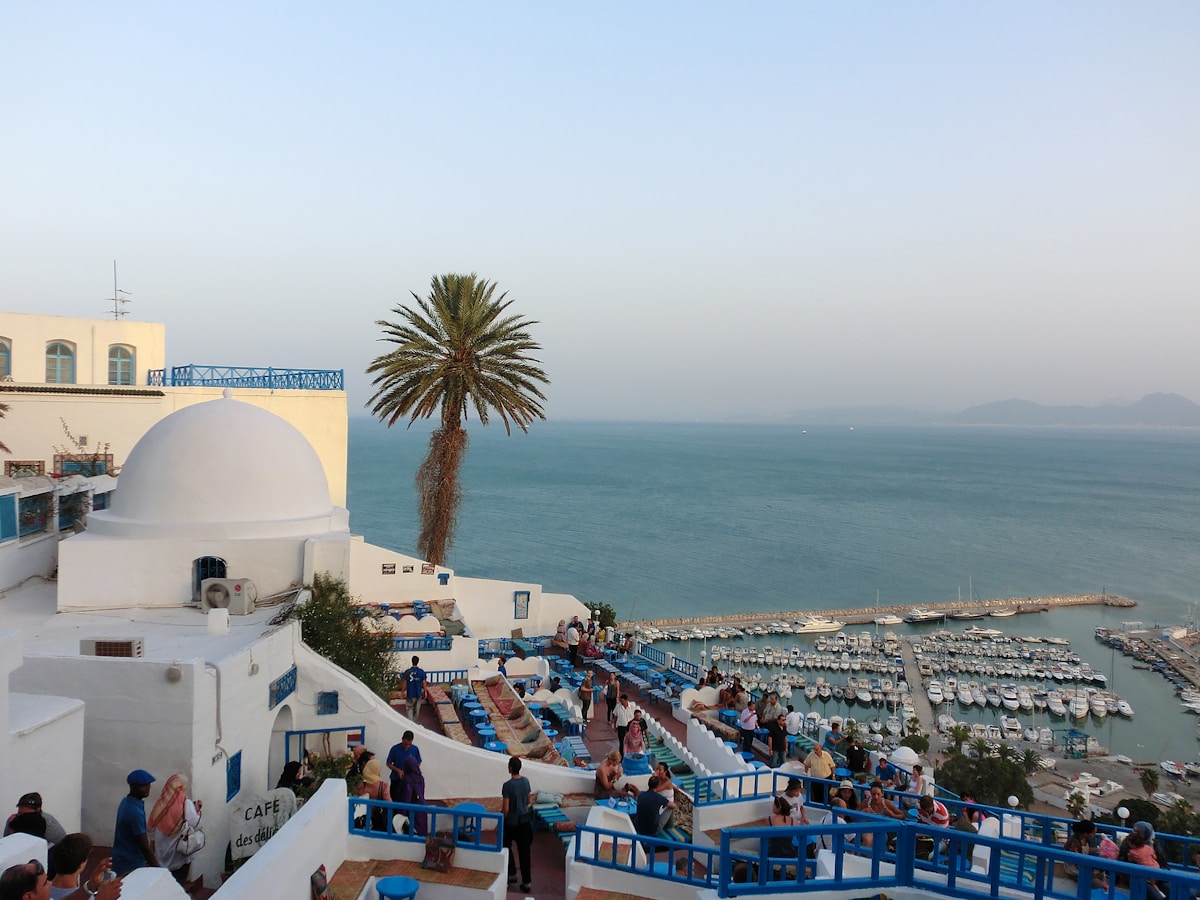
Both Sidi Bou Said and Carthage are on the same TGM light rail line from Tunis, reachable within 20–30 minutes of the city centre. They are the two most popular day trips from the capital - but they could hardly be more different from each other. Sidi Bou Said is a small hilltop village of blue-and-white architecture, cafés, and sea views. Carthage is the site of one of the ancient world’s most important cities, a spread of Punic and Roman ruins across a headland above the Gulf of Tunis. Choosing between them - or finding time for both - is a key question for any visit to Tunis.
At a Glance
| Sidi Bou Said | Carthage | |
|---|---|---|
| Type | Hilltop village, café culture | Archaeological site |
| Distance from Tunis | 20 km | 17 km |
| TGM journey time | ~25 minutes | ~20 minutes |
| Entry cost | Free (village) | ~15 TND combined ticket |
| Time needed | 2–3 hours | 3–5 hours (full site) |
| Best for | Atmosphere, photos, coffee | History, scale, museums |
| Avoid if | You dislike crowds | You’re not interested in ruins |
Quick verdict: Sidi Bou Said delivers an immediate visual and atmospheric reward. Carthage requires engagement with ruins to get the most from it - but rewards that engagement with one of the most historically significant sites in the Mediterranean world. Most visitors benefit from doing both in the same day.
Sidi Bou Said
What it is
Sidi Bou Said sits on a steep cliff above the Gulf of Tunis, about 20 kilometres northeast of the capital. The village takes its name from a 13th-century Sufi saint buried here, and has maintained an aesthetic code since the 1920s - all buildings are whitewashed, and the woodwork (window grilles, shutters, doors) must be painted a specific shade of cobalt blue. The result is one of the most visually striking townscapes in North Africa.
The village experience
The main street - Rue Habib Thameur - climbs steeply from the TGM station to a central square with a café and views across the gulf. The Café des Nattes is the landmark - an upstairs café with rush-matting seating and mint tea that has been photographed by virtually every visitor since the 19th century. Prices reflect the tourist traffic: a glass of mint tea costs approximately 4–7 TND as of 2026.
The walking routes through the village pass blue-doored houses, bougainvillea walls, and the occasional art gallery or crafts shop. The clifftop viewing points give panoramic views across the bay toward Tunis and, on clear days, toward Carthage’s headland to the south.
What to eat and drink
The Café des Nattes is the obvious choice for tea and the traditional almond-pine nut confection (bambalouni doughnuts are also sold by street vendors near the station). For a meal, Restaurant Dar Zarrouk overlooking the gulf has a strong local reputation for Tunisian seafood; expect to pay approximately 50–100 TND per person as of 2026 for a full meal with wine.
Practical notes
Sidi Bou Said gets genuinely crowded on summer weekends - particularly Saturday afternoons when Tunis residents come for the sea air. A weekday morning visit is quieter. There is no significant shade once you leave the cafés; a hat and water are necessary in summer. The village is compact: most visitors cover it fully in two to three hours.
Carthage
What it is
Carthage was one of the ancient world’s greatest cities - the capital of a Phoenician trading empire that controlled much of the western Mediterranean before being destroyed by Rome in 146 BCE. The Romans subsequently built their own city on the same site, which became one of the most important cities in Roman North Africa. The site is now a UNESCO World Heritage Area spread across a residential suburb of Tunis, with ruins distributed across several zones on a headland above the Gulf.
The sites
The scale of Carthage means no single monument dominates - instead, the experience accumulates across several separate zones:
The Antonine Baths - the largest Roman bathhouse complex outside Rome itself. The scale is visible even in ruin; columns have been re-erected to help visitors read the original proportions. Entry included in combined ticket.
The Byrsa Hill - the acropolis of ancient Carthage, now home to the Carthage Museum and a church built over Punic ruins. The views from the top across the Gulf of Tunis are arguably the best in the Tunis area. The museum holds Punic stelae and everyday objects from the pre-Roman city.
The Tophet - a sanctuary where Punic religious practices involving child sacrifice were alleged by Roman sources (the archaeological evidence remains contested). A field of stelae in a quiet garden setting.
The Amphitheatre and Circus - partially excavated; less impressive than El Jem but contextually significant.
The Punic Ports - circular and rectangular harbour basins still visible at the waterline, giving the clearest sense of Carthage’s maritime power.
Time needed
A full Carthage visit takes a minimum of three hours; five hours allows you to cover all zones without rushing. The sites are spread across approximately 2 kilometres - bring comfortable shoes and water. Taxis between zones cost approximately 3–5 TND.
What Carthage lacks
Unlike a contained archaeological park, Carthage’s ruins are embedded in a modern suburb - you walk between villas and parked cars to reach the next zone. First-time visitors sometimes find this disorienting. There is limited on-site explanation at some areas; a guidebook or guided tour helps significantly. GetYourGuide and local operators in Tunis offer half-day guided Carthage and Sidi Bou Said tours for approximately 80–150 TND per person.
Getting There: The TGM Line
Both sites sit on the TGM light rail, which runs from Tunis-Marine station (near the Place de la République) northeast along the Gulf of Tunis coast to La Marsa. Single tickets cost approximately 1 TND as of 2026.
For Carthage: The main stops are Carthage Hannibal (Antonine Baths, Byrsa), Carthage Byrsa, and Carthage Dermech (ports area). Most visitors start at Carthage Hannibal.
For Sidi Bou Said: One or two stops further toward La Marsa, depending on which Carthage stop you exit at. The TGM station deposits you at the foot of the village climb.
Trains run approximately every 15–30 minutes. The line is safe, air-conditioned on newer trains, and straightforward to use. A TGM map is displayed at each station.
How to Do Both in One Day
The standard approach and the one we recommend:
- TGM from Tunis-Marine, arrive Carthage Hannibal by 9:00
- Visit Carthage 9:00–13:00 - Antonine Baths first, then Byrsa Hill and museum, then Tophet and ports if time permits
- Lunch near Carthage Byrsa or take TGM to Sidi Bou Said (5 minutes)
- Sidi Bou Said 13:30–16:30 - walk the village, Café des Nattes, clifftop views
- Return to Tunis by TGM - approximately 25 minutes
This day requires moderate fitness (Byrsa hill + Sidi Bou Said hill), comfortable shoes, and a hat in summer. Total cost including entry tickets and lunch: approximately 40–70 TND per person.
Which to Prioritise If You Only Have Time for One
Choose Sidi Bou Said if: You want a visually rewarding, low-effort afternoon with café culture, views, and good photographs. You are not particularly interested in archaeology. You want something to do on a short half-day.
Choose Carthage if: History is your primary interest. You want to understand the depth of civilisation in this part of the Mediterranean. You have a guide or have read about the Punic world beforehand - context makes Carthage significantly more rewarding.
The honest recommendation: The TGM makes combining them so easy that there is rarely a good reason to do only one. Plan the full day and do both.
For more on what to do around Tunis, see our Tunis destinations guide and our overview of getting around Tunisia. If you’d prefer a guided day with transport sorted, our Tunis, Carthage and Sidi Bou Said tours guide covers the best options. For detail on the archaeological sites specifically, see our Carthage ruins guide. Make sure you have travel insurance for Tunisia in place before you travel.
Plan Your Trip
✈️ Book your flights to Tunisia 🛡️ Get travel insurance 📱 Stay connected with an eSIM 🚗 Rent a car