Ichkeul National Park holds three of the world’s most significant nature conservation designations simultaneously — UNESCO World Heritage Site, UNESCO Biosphere Reserve, and Ramsar Wetland of International Importance. That combination is exceptionally rare. What makes it rarer still is the ecosystem that earned them: a shallow freshwater lake, a saltwater lagoon, and a limestone mountain packed into roughly 12,600 hectares near the town of Bizerte in northwestern Tunisia.
Between November and February, somewhere between 200,000 and 300,000 migratory waterbirds arrive to winter here. This is one of the largest gatherings of migratory birds anywhere in North Africa or the Mediterranean, and the main reason most visitors make the trip.
The ecosystem
Ichkeul’s importance depends on a delicate water chemistry. Lake Ichkeul covers approximately 8,900 hectares and sits just inland from the sea. It is connected to the Mediterranean via the Oued Tinja river, which flows to Lac de Bizerte and from there to the sea. Crucially, the direction of flow reverses seasonally: in winter, freshwater from seasonal streams fills the lake and dilutes its salinity; in summer, the lake level drops and saline water from Lac de Bizerte flows inward, increasing the salt concentration.
This seasonal oscillation between fresh and brackish conditions supports an unusually diverse aquatic plant community — particularly the aquatic grass Potamogeton pectinatus (sago pondweed) and several bulrush species that grow in the margins. These plants form the food base for the enormous flocks of wintering ducks, grebes, and other waterbirds.
Jebel Ichkeul (511 m) rises sharply from the lake’s southern shore. The mountain carries one of the few remaining areas of native Mediterranean forest in Tunisia, with cork oak, wild olive, lentisk, and Aleppo pine. Buffalo introduced during the colonial period still roam the hillsides — Ichkeul is the only site in North Africa where wild water buffalo survive.
Birdwatching
More than 180 bird species have been recorded at Ichkeul. The winter concentrations are the main draw:
- Ducks: pintail, teal, shoveler, pochard, and tufted duck arrive in their tens of thousands. Total duck counts regularly exceed 100,000 in good winters.
- Grebes and coots: great crested grebes, little grebes, and coots are numerous through winter.
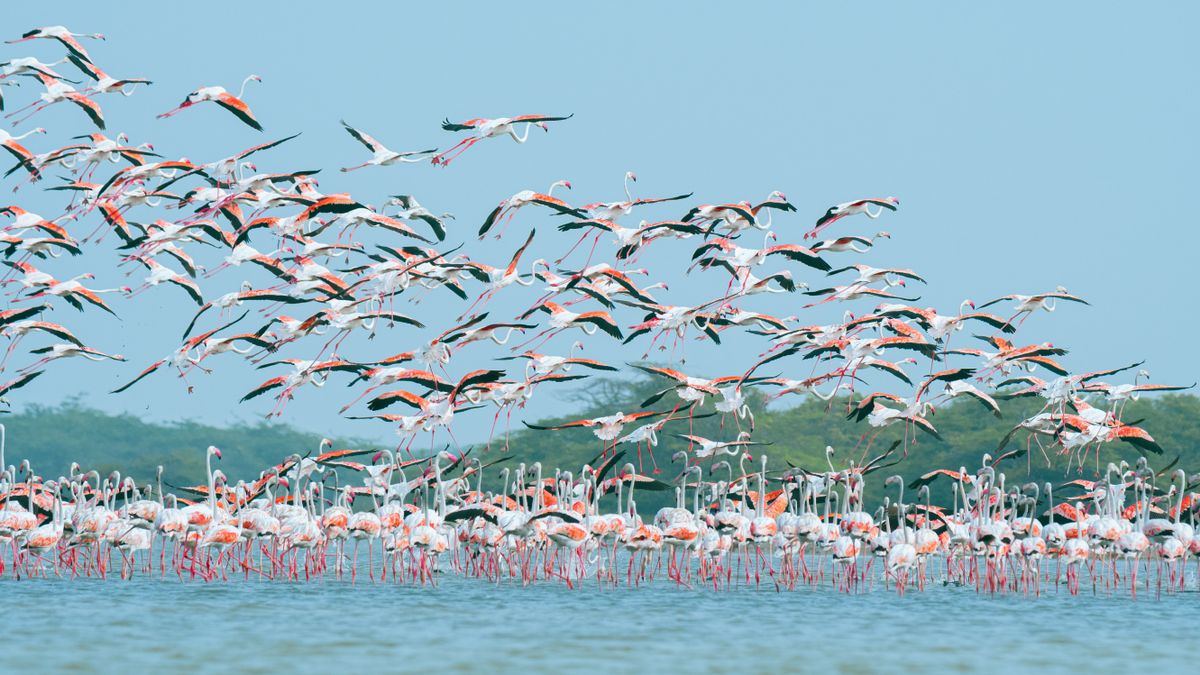
- Flamingos: flocks of greater flamingo are present year-round but most visible in winter, feeding in the shallow margins.
- Storks and cranes: white stork and Eurasian crane use the wetland as a staging post during migration.
- Raptors: marsh harrier hunts the reed margins regularly. Osprey, peregrine, and short-toed eagle are all recorded.
- Waders: in autumn and spring migration windows (September–October and March–April), godwits, sandpipers, stilts, and avocets pass through in smaller numbers.
The lake is best observed from the northern shore track accessible from the park entrance, and from the area around the ecomuseum. There are no permanent hides, but the flat terrain and open water allow good views with binoculars or a spotting scope.
What to do at Ichkeul
Birdwatching from the lake shore
The track running along the northern and western margins of the lake gives the best access to the open water. Early morning visits in winter — arriving by 08:00 — give the most productive birding before bird activity settles mid-morning. Bringing your own binoculars is essential; there is no equipment hire at the site.
Hiking Jebel Ichkeul
A marked trail climbs from the park entrance area to the summit of Jebel Ichkeul (511 m). The round trip takes approximately 2.5–3 hours. Views from the summit cover the lake, the coastal plain, and on clear days, the Gulf of Tunis to the east and the hills of northern Tunisia. The mountain trail is less visited than the lake shore and gives a different perspective on the ecosystem. Spring visits bring wildflowers across the slopes.
The ecomuseum
A small ecomuseum near the park entrance provides background on the ecology, hydrology, and conservation history of the site. Displays cover the water management challenges of the 1980s and 1990s and the restoration efforts that followed. The ecomuseum is included in the park entry fee and takes around 30–45 minutes to cover.
A conservation story
Ichkeul’s story is not straightforwardly positive. In the 1980s and 1990s, the Tunisian government built six dams on the rivers feeding the lake as part of a national water supply programme. The dams reduced freshwater inflows dramatically, causing the lake’s salinity to rise year-round. The aquatic plants that the wintering birds depended on declined sharply; wintering waterbird counts fell by 80–90% through the 1990s. UNESCO placed Ichkeul on the World Heritage Danger List in 1996.
Restoration efforts from the late 1990s onward — including partial reversal of dam operations to restore seasonal freshwater pulses — gradually improved conditions. Aquatic plant cover recovered significantly through the 2000s, and bird numbers partially rebounded. UNESCO removed Ichkeul from the Danger List in 2006. The site now serves as a case study in the difficulty of balancing conservation with regional water demands — an ongoing tension rather than a solved problem.
Getting to Ichkeul
By car: The most practical option. From Tunis, take the A4 motorway to Bizerte (approximately 65 km), then the GP7 toward Mateur. The park entrance is signposted off the GP7 roughly 20 km south of Bizerte, near the village of Tinja. Total journey from Tunis: around 80 km, approximately 1 hour.
By public transport: Take a louage or bus from Tunis to Mateur (direct services are available; approximately 1 hour). From Mateur, the park entrance is roughly 10–12 km — take a local taxi. Expect to pay approximately 10–15 TND for the taxi from Mateur. Confirm the driver will wait or arrange a return time.
From Bizerte: Bizerte is 25 km from the park entrance via the P11 road. It makes sense to combine an Ichkeul visit with a morning or afternoon in Bizerte — the old port, kasbah, and medina are all worth a few hours.
Entry fee and opening hours
- Entry fee: approximately 5 TND per person (as of 2025); includes the ecomuseum
- Summer hours: 07:00–18:00
- Winter hours: 07:30–17:00
- Payment: cash only at the park entrance
There are basic toilet facilities near the ecomuseum. No café or food is available inside the park — bring water and food for a half-day visit.
When to visit
November to February for birdwatching at peak numbers. Waterbird concentrations are highest December–January. Mornings are cold and can be foggy; dress accordingly.
March to April for spring migration and wildflowers on Jebel Ichkeul. Fewer birds than winter but more species diversity as migrants pass through.
May to October is the quiet season. The lake levels drop and salinity rises; waterbird numbers are low. The mountain trail and ecomuseum remain accessible. Summer heat (July–August regularly exceeds 35°C) makes midday visits uncomfortable.
Ichkeul is less than 90 minutes from Tunis and fits comfortably into a day trip combined with a stop in Bizerte. The combination — lake, mountain, and one of Tunisia’s less-visited historic towns — makes for a full and varied day away from the main tourist circuit.