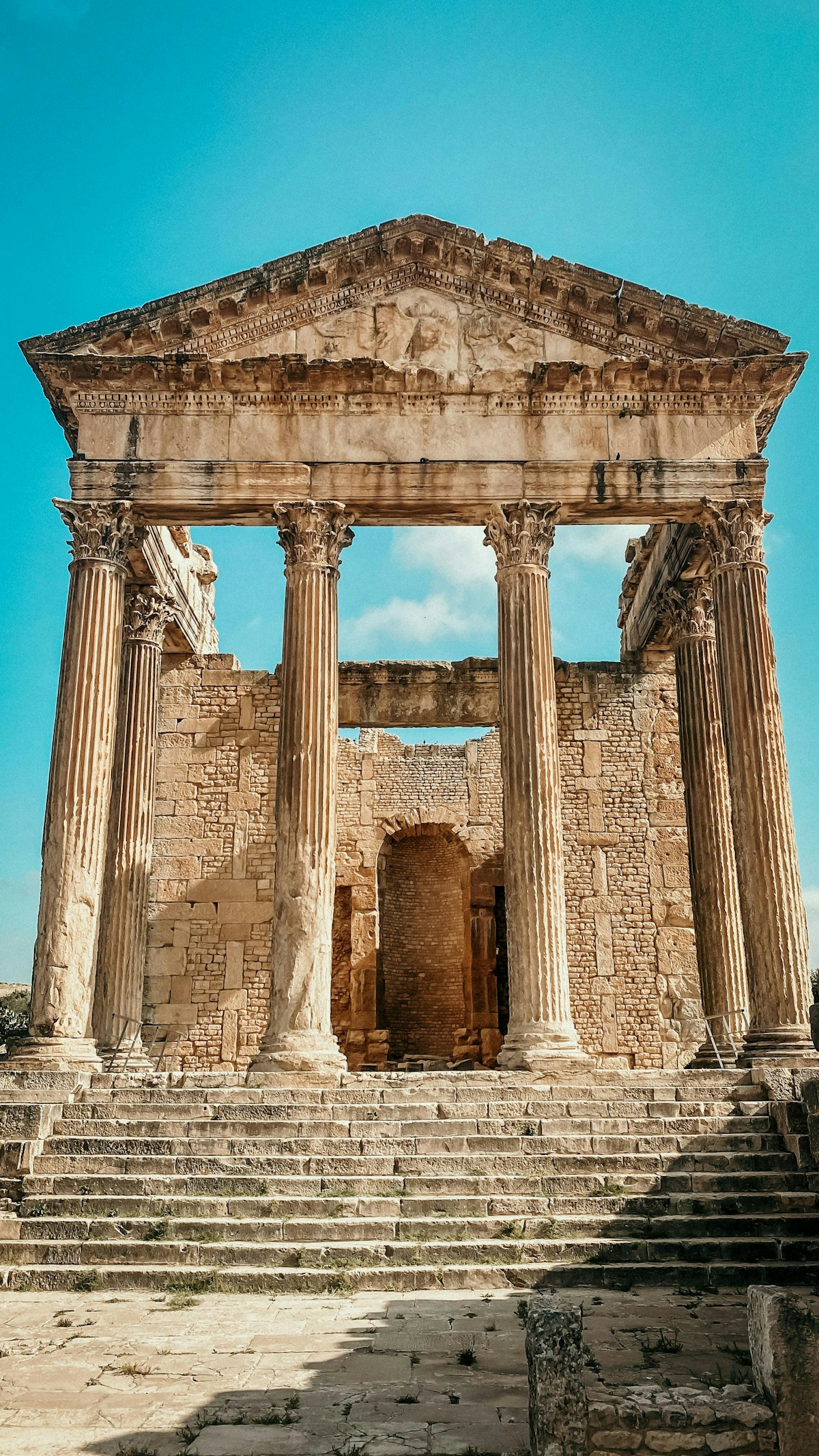
Dougga is the most complete Roman city in North Africa and, for many visitors, the most impressive ancient site in Tunisia. It sits on a hillside above the Medjerda valley, 110 kilometres southwest of Tunis, and it has one significant advantage over other Roman sites: it was never built over. The medieval settlement that grew up here was relocated in the 1950s, leaving the Roman and pre-Roman layers almost entirely intact and readable from the ground.
The site is a UNESCO World Heritage Site and covers approximately 65 hectares. A full visit takes 2.5–3 hours. Here is what to prioritise.
The Capitol temple
The Capitol is the defining image of Dougga and one of the best-preserved Roman temples in the world. Dedicated to Jupiter, Juno, and Minerva and built in 166 CE under Emperor Marcus Aurelius, it stands almost complete: the six-columned Corinthian portico is intact, the pediment sculpture is largely in place, and the cella (inner sanctuary) behind it is clearly identifiable. The steps are original and the worn stone gives a sense of the foot traffic over two millennia.
The elevated position of the Capitol - it sits on the high ground at the centre of the site - makes it visible from almost everywhere in Dougga. It is worth approaching from below and climbing the steps slowly, then turning around for the view across the valley.
No additional entry beyond the site ticket. The Capitol is part of the general site circuit.
The theatre
The theatre at Dougga was built in 168–169 CE and seated approximately 3,500 spectators. The semicircular cavea (seating tiers) is cut into the hillside and survives in very good condition. The scaena (stage building) behind the orchestra has been partially reconstructed. From the upper tiers, the views across the surrounding countryside are exceptional.
The theatre still hosts an annual festival of classical and world music (usually in late summer - check local listings for dates). Attending a performance here is one of the more distinctive experiences available in Tunisian cultural tourism.
The Numidian mausoleum (Libyco-Punic Mausoleum)
This is one of the most important pre-Roman monuments in North Africa. Built in the 3rd or 2nd century BCE for a Numidian king, the mausoleum predates the Roman city and stands as evidence of the sophisticated indigenous civilisation that preceded Roman conquest. It is a three-storey tower structure with Egyptian, Greek, and local Numidian architectural elements mixed together - an indicator of the cultural complexity of pre-Roman North Africa.
The British consul removed the carved inscription in the 19th century (it is now in the British Museum in London). What remains is the carved stone structure itself, which is largely intact.
The Arch of Septimius Severus and the forum
The triumphal arch built in honour of Emperor Septimius Severus (who was himself from North Africa - born in Leptis Magna, in modern Libya) stands at the edge of the forum area. The forum itself, the main civic space of the city, is flanked by the ruins of civic buildings and gives a strong sense of how a functioning Roman town was organised.
The market building (macellum) adjacent to the forum has inscribed counters and measuring stones - evidence of the regulated commercial life that made Roman cities function.
The baths and residential quarter
Dougga has multiple bath complexes of different periods. The Cyclops Baths and the Licinian Baths are the most interesting, with mosaic floors (some original, some removed to Tunis) and the infrastructure of Roman bathing - hypocaust heating systems, plunge pools, changing rooms - all visible.
The residential quarter in the lower part of the site has several townhouses with intact courtyard layouts and traces of decoration. House of the Trifolium and House of Dionysos are the two most visited.
Practical information
Entry: approximately 8 TND for the site, 3 TND additional for parking as of 2026. Verify fees locally before visiting.
Opening hours: 08:00–19:00 (summer), 08:30–17:30 (winter) Tuesday–Sunday. Closed Monday.
Getting there: Dougga is not served by direct public transport. The nearest town is Téboursouk (8 km). Options from Tunis:
- Car hire: the most practical option. The drive from Tunis takes approximately 1.5 hours on the P5 highway. Parking is at the site entrance.
- Organised day tour: see our best tours in Tunisia guide for operators that include Dougga, or book a Dougga day trip from Tunis on GetYourGuide.
- Bus + shared taxi: bus from Tunis to Téboursouk (approximately 2 hours), then a shared taxi or local taxi to the site (approximately 8 km).
What to bring: wear comfortable shoes - the site involves uneven ancient paving and uphill walking. Bring water and sunscreen; there is almost no shade at the site. A hat is essential in summer.
Combining Dougga with other sites
Dougga pairs well with Kairouan for a full-day circuit from Tunis, though this requires a car and covers significant distance. A more relaxed approach is to base overnight in Tunis and make Dougga a dedicated day trip, allowing time to walk the whole site without rushing.
Search hotels in Dougga on Booking.com
Plan Your Trip
✈️ Book your flights to Tunisia 🛡️ Get travel insurance 📱 Stay connected with an eSIM 🚗 Rent a car