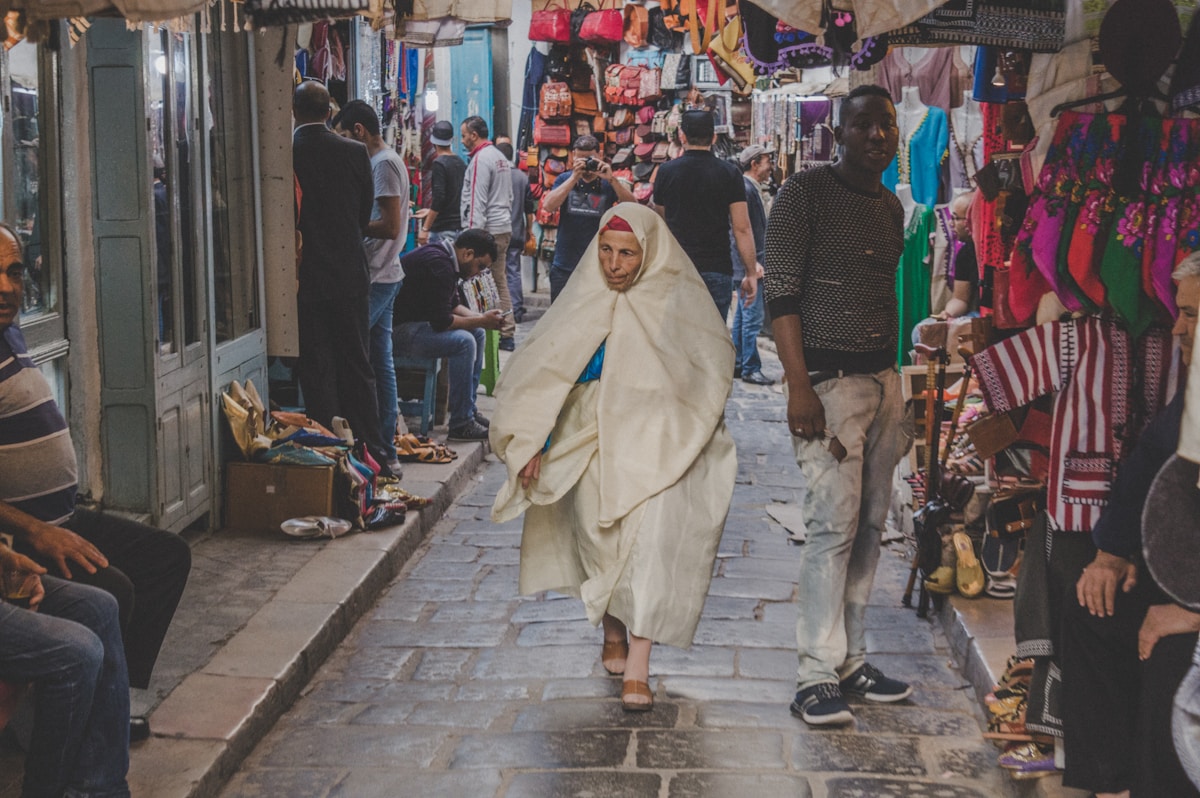
The medina of Tunis is a UNESCO World Heritage Site and one of the finest examples of medieval Arab urban planning anywhere in the world. Within its roughly 270 hectares, nearly 700 historic monuments are packed into a labyrinth of covered souks, mosque courtyards, palace facades, and residential lanes - most unchanged in their essential layout since the 12th century.
It rewards unhurried wandering. There are major landmarks to anchor your route, but the medina’s real pleasure is in the detail: an elaborately carved wooden door on a side street, the smell of jasmine from a garland seller, the sound of a craftsman shaping a copper tray.
Orientation
The medina is roughly rectangular, with the major axis running east–west from Bab el Bhar (the Sea Gate, linking to the modern city on Avenue Habib Bourguiba) to Bab el Djazira in the west. The main commercial artery - Rue de la Kasbah and its extensions - runs through the middle.
The Great Mosque of Zitouna (Great Olive Tree Mosque) is the spiritual and geographic centre of the medina. Most of the important souks radiate from its immediate vicinity. Navigation tip: if you are unsure of your position, navigate toward the minaret.
The medina has three main entry points for visitors:
- Bab el Bhar (east) - closest to the new city, the TGM station, and most taxis
- Bab Menara (north) - access to the upper medina and the Hafsia quarter
- Bab Souika (northeast) - the most local-feeling entry, less touristy
The Souks
The medina’s souks are organised by trade - a medieval specialisation that largely persists today.
Souk el Attarine (next to Zitouna mosque): Spices, perfume waters, and essential oils. The scent alone is worth the visit. Look for rose water (approximately 5–8 TND for 500ml) and harissa paste (approximately 3–5 TND for a jar of quality home-produced red).
Souk des Chéchias: The chechia is Tunisia’s traditional red felt hat, and this souk has produced them for centuries. Watching the hats being blocked and shaped is a craft demonstration in real time. A plain chechia costs from approximately 15 TND; decorated or embroidered versions from approximately 30–60 TND.
Souk des Étoffes: Silk, brocade, and traditional dress fabrics in layered stalls. The richly coloured textiles are used for traditional dress and make distinctive gifts.
Souk du Cuivre: Copper and brass - trays, lamps, pots - hand-hammered in workshops that open directly onto the souk lanes. Quality varies; examine pieces for evenness of hammering and weight.
Souk des Bijoutiers (Jewellers’ Souk): Gold and silver jewellery in a long covered gallery. Tunisian designs often feature Berber motifs - hand of Fatima pendants (main fatma), amber beads, and filigree work.
Key Monuments
Great Mosque of Zitouna
Founded in 732 CE, Zitouna is the oldest and most important mosque in Tunisia, and the spiritual heart of the medina. Non-Muslim visitors cannot enter the prayer hall, but the entrance courtyard is visible from the souk and the imposing carved wooden door and minaret are clearly seen from several vantage points. The mosque is also the site of one of the oldest universities in the world, pre-dating Oxford by several centuries.
Dar Ben Abdallah Museum (Museum of the City of Tunis)
A beautifully restored 18th-century palace turned municipal museum, free to enter. Displays include traditional Tunis household objects, costumes, and reconstructions of domestic life across different social classes. The interior courtyard - tiled, with a central fountain and carved plaster screens - gives the best impression available to visitors of what elite medina architecture looks like behind the doors.
Open: Typically Tuesday–Sunday, approximately 09:00–16:00. Admission free.
Zaouia Sidi Brahim
One of several Sufi shrines (zaouias) woven into the medina’s fabric. These whitewashed buildings with tiled interiors are generally open to visitors during daytime. The architecture - carved stucco, zellige tile floors, arched colonnades - is among the most refined in the medina.
Tourbet el Bey
The royal mausoleum of the Husainid dynasty - the beys who ruled Tunisia under Ottoman suzerainty from 1705 to 1957. The building combines Andalusian, Ottoman, and local North African decorative traditions in a way you won’t find anywhere else. Generally open to visitors for a small entry fee (approximately 5–8 TND).
Kasbah Mosque
At the far western end of the medina, the 12th-century Kasbah mosque is one of the finest examples of Almohad architecture in existence. The striped stonework minaret is the model for dozens of later minarets across North Africa.
Practical Navigation
The medina’s lanes are narrow and many dead-end. Getting slightly lost is part of the experience and rarely a problem during daylight - the lanes eventually funnel back toward a main artery.
Street names are marked in French and Arabic on tiled plaques on the walls, but coverage is inconsistent. Offline maps (Maps.me or Google Maps offline area download) are helpful to orient yourself between landmarks.
Touts and guides: Offers of free guidance (“my uncle’s shop…”) are common near Bab el Bhar. Politely decline if you want to browse on your own terms. If you want an official guide, book through the ONTT (Office National du Tourisme Tunisien) near Bab el Bhar - licensed guides charge approximately 60–80 TND for a 2–3 hour walk.
Café and lunch options: Café M’rabet in the Souk el Trouk is one of the oldest cafés in the medina and serves traditional mint tea (approximately 3 TND) in a tilework interior. For lunch, several restaurants near the Zitouna mosque serve Tunisian staples - expect to pay approximately 15–30 TND for a full meal.
Best time: Early morning (08:00–10:00) before tourist groups arrive, or late afternoon (16:00–18:00) when light is warm and locals fill the cafés. Avoid Friday mid-morning when the mosque calls draw large crowds.
After the medina, the most popular day-trip combination from Tunis is Carthage and Sidi Bou Said - both reachable by TGM light rail. For dining recommendations across the city, see our Tunis restaurants guide. For food-focused experiences - medina food walks, cooking classes, and market tours - see our Tunis food tours guide. If you are staying in the area, our best hotels in Tunis guide covers all the main options. A guided tour of Tunis is worth considering for your first morning - a local guide covers the medina’s history and neighbourhoods in ways that signage alone can’t convey.
Search hotels in Tunis on Booking.com
Plan Your Trip
✈️ Book your flights to Tunisia 🛡️ Get travel insurance 📱 Stay connected with an eSIM 🚗 Rent a car