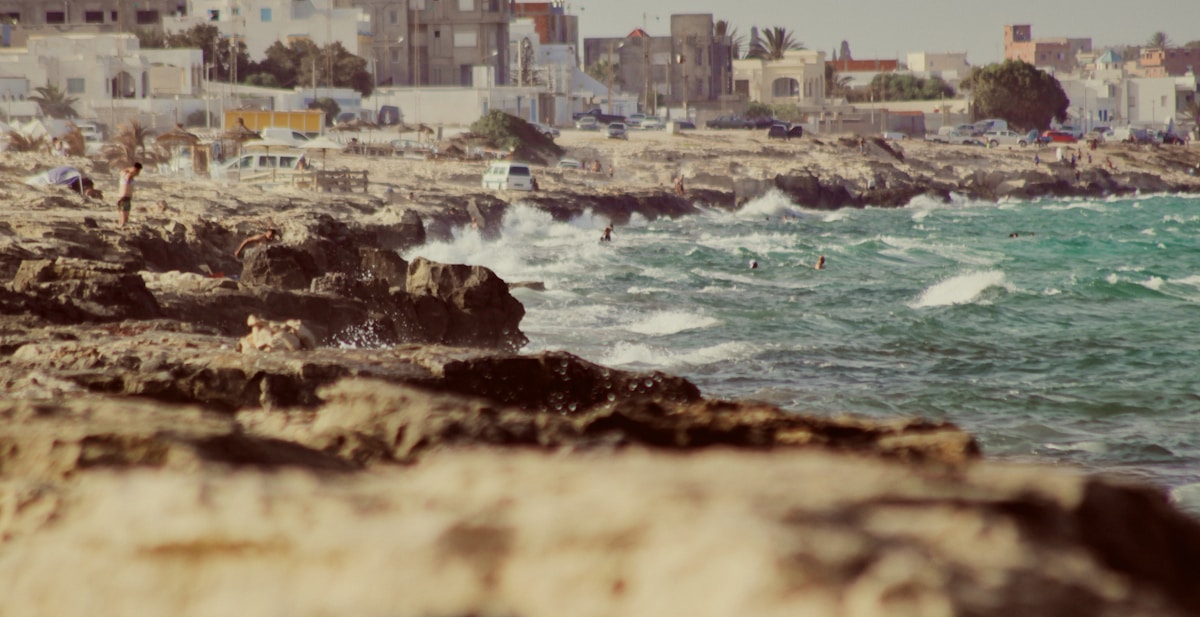
The Kerkennah Islands sit about 20 kilometres east of Sfax in the Gulf of Gabès, barely rising above sea level. There are two main islands - Chergui and Gharbi - connected by a Roman causeway still in use today, plus several smaller uninhabited islets. The total land area is small, the highest point is a few metres above the sea, and the coastline is mostly shallow rocky shore with sandy coves.
What makes Kerkennah distinctive in the Tunisian context is precisely what it lacks: no beach resorts in the European sense, no all-inclusive complexes, no organised tourist circuit. What it has is quiet, clear, shallow water; a functioning fishing culture; and a pace of life that has not been recalibrated for tourism. For a full breakdown of accommodation options on the islands, see our where to stay in the Kerkennah Islands guide.
Getting to Kerkennah
The only access is by SONOTRAK ferry from Sfax commercial port. Several sailings depart daily in both directions, increasing to 8–10 round trips in peak summer. The crossing takes approximately 1 hour 15 minutes to Sidi Youssef, the main arrival point on Chergui island.
Ferry fares (approximately, as of 2026):
- Foot passenger one-way: 2–3 TND
- Car one-way: approximately 20–30 TND
- Motorbike one-way: approximately 10 TND
Taking a vehicle is worth considering, as local transport on the islands is limited to a few shared taxis and horse-drawn caleches. Cycling is the best way to explore - bicycles can be rented in Remla for approximately 8–12 TND per day.
The Islands: What to See and Do
Remla
Remla is the main town on Kerkennah, a modest settlement with a small souk, a handful of cafes, and basic shops. The market on Remla’s main street sells local dates, olives, and the island’s distinctive handwoven baskets made from date palm leaves. It is the functional centre of island life rather than a tourist showpiece, but worth an hour of exploration on any visit.
Sidi Frej and the Western Coast
Sidi Frej, on the western side of Chergui, has the best organised beach area on the islands and is where the main tourist hotel is located. The water here is exceptionally shallow - the Gulf of Gabès is one of the shallowest stretches of the Mediterranean - and the beach shelves very gently. On a calm day you can wade 200 or 300 metres from shore in waist-deep water.
The Grand Hôtel Cercina at Sidi Frej is the reference point for tourist accommodation on the island. Rooms cost approximately 120–200 TND per night as of 2026, including half-board in many packages. Several smaller guesthouses in Remla offer rooms from approximately 60–90 TND per night.
Search hotels in Sfax on Booking.com
Beaches: El Attaya and Beyond
The beaches on Kerkennah are not wide sandy stretches in the package-holiday sense - the shoreline is mostly shallow, rocky, and fringed with sea grass. The best sandy areas are at El Attaya on the east coast of Chergui, where the water is very shallow and calm, and at Sidi Frej on the west side. Both suit slow swimmers and families with young children; the gradual shelving means there is no sudden depth drop.
The mudflats and lagoons around the quieter parts of the coast attract wading birds year-round, and in spring and autumn greater flamingos stop on the islands during migration. The Gulf of Gabès is an important feeding ground, and early morning walks along the lagoon edges - particularly on the less-visited western shore of Gharbi - can produce good sightings.
Charfia Fishing
The most unusual feature of Kerkennah is the traditional octopus fishing practice called charfia, which uses palm-frond barriers staked into the shallow sea floor to guide octopuses into collection points. The structures are visible from the coast and from the ferry - rows of palm branches rising from the water at odd angles. This form of fishing is specific to the Kerkennah Islands and the Gulf of Gabès and has been practiced for centuries.
The octopus caught by charfia methods is served fresh in island restaurants. Grilled octopus, octopus in olive oil and capers, and octopus salad are the local specialities. Sea urchin, harvested from the shallow rocky shallows, appears on menus in season - eaten simply with bread and lemon, it is one of the most distinctively Kerkenni things you can order.
Gharbi Island and the Roman Causeway
The smaller island of Gharbi is connected to Chergui by the ancient causeway, and much of its coastline is accessible by bicycle or on foot. The western tip of Gharbi is undeveloped and has calm, clear water suitable for swimming when the wind drops. The Roman causeway itself - dating to the 1st or 2nd century AD - is a remarkable piece of infrastructure to find connecting two small North African islands.
Where to Eat on Kerkennah
Fresh seafood is the reason to eat on Kerkennah rather than deferring until Sfax.
Restaurant Le Sirène near Sidi Frej is one of the better-known fish restaurants, serving grilled fresh catch at approximately 20–35 TND per person including a mezze of small salads.
Restaurant Bou Jaffar in Remla does strong local cooking - octopus, sea bream, mullet - at lower prices, typically 12–20 TND per person.
Most cafes in Remla serve strong Tunisian coffee and mint tea with sesame cakes (makroudh) for a few dinars.
A Literary Footnote
George Orwell spent several weeks on Kerkennah in 1938–39, convalescing from tuberculosis after his return from the Spanish Civil War. He lived quietly on the islands while working on material that would eventually feed into his later writing. The fact that one of the twentieth century’s most significant English writers chose this particular spot - obscure, flat, and slow-paced even by Tunisian standards - is a small piece of history that the islands wear lightly. There is no museum and no commemorative plaque, which, in a way, is entirely appropriate.
Practical Information
Getting around: Shared taxis run a circuit around the main island and can be flagged down on the roadside. A ride from Sidi Youssef to Remla costs approximately 3–5 TND. Horse-drawn caleches are available near the ferry terminal and offer rides through the lanes for approximately 15–25 TND per hour.
Facilities: Remla has a bank, a pharmacy, and a post office. ATMs can be unreliable; bring cash from Sfax.
Mobile coverage: Coverage is generally good on the main island. Tunisie Telecom and Ooredoo both work.
What to bring: The sun on the islands is strong, and there is little shade on the beaches. Sunscreen, a hat, and water are essential. In shoulder season (April–May, September–October), bring layers for evenings, which can be cool.
Kerkennah vs. Djerba
Travellers sometimes compare the two Tunisian islands. Djerba is larger, more developed, and better equipped with hotels and restaurants aimed at international visitors. Kerkennah is smaller, quieter, and offers almost no tourist infrastructure in the Djerba sense. For travellers who want a beach resort experience, Djerba or Hammamet are better choices. For those who want genuinely quiet coastline and a functional fishing community with minimal tourism overlay, Kerkennah is the better option.
The two islands also serve different purposes within a Tunisia itinerary. Djerba works as a standalone beach destination and can be reached by direct flights. Kerkennah requires a transit through Sfax, which makes it more appropriate for travellers building a broader southern Tunisia route that already includes Sfax, El Jem, or the desert south.
Before you travel, have travel insurance for Tunisia in place to cover ferry disruptions, medical costs, and other travel mishaps.
Plan Your Trip
✈️ Book your flights to Tunisia 🛡️ Get travel insurance 📱 Stay connected with an eSIM 🚗 Rent a car