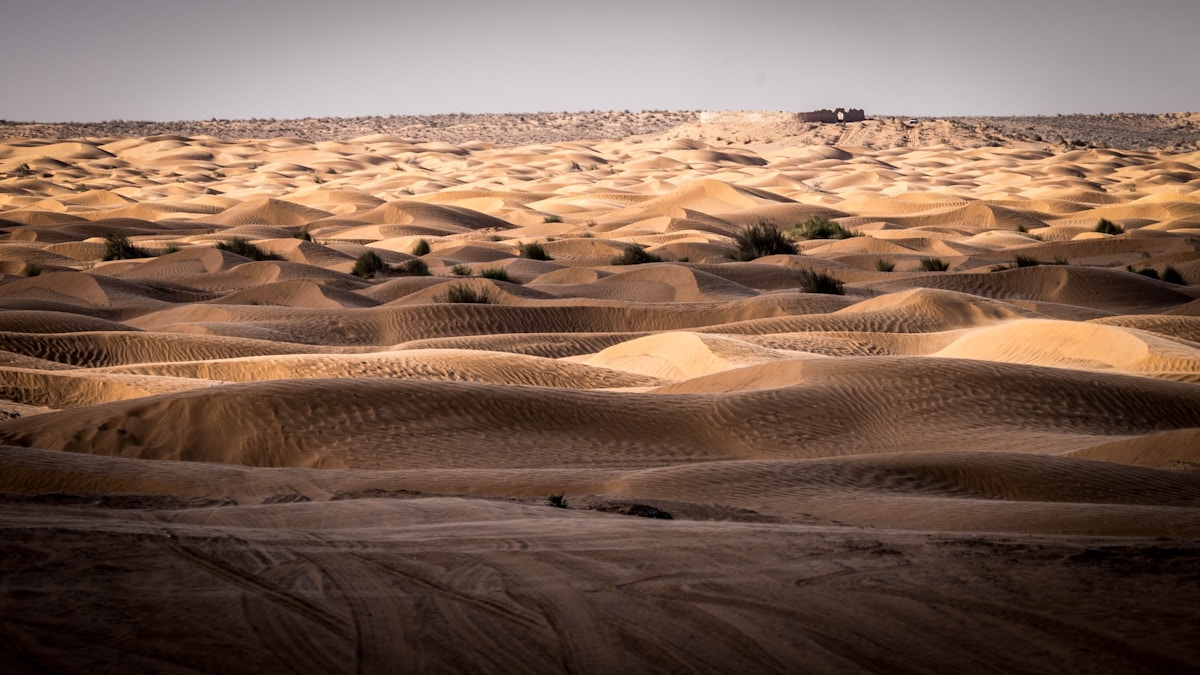
Chott el Jerid is unlike anywhere else in Tunisia - and unlike almost anywhere else in the world. It is best visited as part of a stay in Tozeur, the natural gateway town to the south. Stretching for roughly 250 km east to west and up to 80 km from north to south, this vast endorheic salt lake occupies the low-lying depression between the northern and southern ranges of the Atlas mountains. For most of the year it is a dry, blinding white expanse of salt crust. After winter rains, shallow water transforms it into a mirror that turns pink and orange at dawn and dusk.
The main crossing road - the RN16 causeway from Tozeur south to Kebili - passes directly over the chott and provides easy access to the landscape without a 4WD.
What You’ll See
The Salt Crust and Crystal Formations
In dry conditions (May through October), the chott surface is exposed salt crust - cracked into geometric patterns, studded with salt crystal formations, and glittering under the sun. Walking out a short distance from the road (only in areas marked safe by guide posts or where a guide confirms stability) gives an extraordinary sense of the scale and silence. There are no sounds except wind; the horizon disappears into heat shimmer on all sides.
Salt flowers - natural formations of gypsum and halite - occur near the edges of the chott and are sold in Tozeur as souvenirs (approximately 5–15 TND for a small cluster). The larger natural specimens near the chott itself are more impressive than anything in a shop.
Mirages
Chott el Jerid is one of the best places in the world to see natural mirages. In summer, heat shimmer creates persistent illusions of water on the horizon - entire “lakes” that shift and disappear as you move. In the cooler months, the effect is less pronounced but still visible on sunny afternoons.
Winter Water and Colour
After significant rainfall (typically December–February), the chott holds shallow saline water - sometimes just a few centimetres deep, enough to reflect the sky. The bacteria in the water - halophilic organisms that thrive in high-salinity environments - turn the water pink, orange, or red. Photographs taken at this time of year can look almost identical to Bolivia’s Salar de Uyuni.
Star Wars Filming Location
Parts of the chott and surrounding desert were used as locations for the original Star Wars trilogy. The Lars Homestead set (Luke Skywalker’s home in A New Hope) was filmed near Tataouine further south, but the landscape of Chott el Jerid served as a visual reference for the film’s Tatooine planet. The town of Tozeur itself was used in The Phantom Menace. For a full guide to every filming location in Tunisia, see our Star Wars filming locations guide.
The RN16 Crossing
The main road between Tozeur and Kebili crosses the chott via a paved causeway built in the 1970s. The drive is approximately 70 km and takes about an hour without stops. The road is in reasonable condition and suitable for any standard vehicle in dry weather.
Stop points along the crossing:
- Degache turn-off (north end): Small oasis town, last fuel and shops before entering the chott
- Midpoint rest area (approximate km 35): A cluster of stalls selling salt crystal formations, woven goods, and cold drinks. Prices are negotiable - 5–10 TND for a reasonable salt formation souvenir. Several camels are kept here for tourist photographs (approximately 5–10 TND per photo).
- Kebili (south end): A small town with a medina and date palm groves. Louages continue south to Douz from here.
Do not drive off the paved road onto the chott surface. The crust looks solid but can conceal deep saline mud that will swallow a vehicle instantly.
Getting There
From Tozeur: The RN16 starts in Tozeur - simply follow the main road south out of town. You’re on the chott within 15 minutes.
From Tunis by car: Approximately 450 km, allow 5 hours. The drive south from Gafsa passes through increasingly arid landscape before the chott opens up south of Tozeur.
By organised tour: Most Sahara day tour operators in Tozeur include a crossing of the chott as part of their full-day itinerary. Expect to pay approximately 120–200 TND per person for a guided day with a 4WD, including the chott, mountain oases, and Sahara dunes. Compare prices locally and confirm what is included. You can also browse Sahara tours from Tunis that include the Chott el Jerid crossing as part of a longer southern itinerary.
By louage: Regular louages run from Tozeur to Kebili (approximately 1.5 hours, from around 8–10 TND). You can ask to be dropped at the roadside midpoint, though returning requires flagging down a passing vehicle or pre-arranging pickup with a tour operator.
Combining with Tozeur
Tozeur is the natural base for a Chott el Jerid visit. The town is worth an afternoon in its own right:
- The Medina: Tozeur’s old city is built from distinctive yellow brick in geometric patterns unique to the town. The main souks sell dates (Deglet Nour, the local variety, from approximately 5 TND per kg), spices, and traditional pottery.
- Chak Wak Theme Park: A somewhat kitsch but entertaining science and nature park with reconstructed prehistoric scenes and a section on desert ecology. Entry approximately 15 TND.
- The Mountain Oases: Just 20 km west of Tozeur, a series of gorge oases (Chebika, Tamerza, Mides) cut through the Atlas mountains. These are accessible by car or 4WD and are typically combined with the chott crossing on a day tour. The waterfalls at Tamerza (often reduced to a trickle in summer) and the dramatic canyon at Mides are the highlights.
If you are planning a multi-day desert route, our Tozeur vs Douz comparison helps you choose the right southern base. For guided tours from Tozeur including the Chott, mountain oases, and Star Wars sites, see our Tozeur and Sahara desert tours guide. For a structured itinerary, see our Sahara desert tour. A hire car is the most flexible way to cross the chott and combine it with Douz and Tozeur on your own schedule.
Practical Tips
- Water: The salt flats in any season require 2+ litres per person minimum. There is no shade once you leave the road. The midpoint stalls sell bottled water from approximately 2–3 TND.
- Sun protection: The reflected glare off salt is intense - UV-protective sunglasses (not just tinted), sunscreen, and a hat are non-negotiable.
- Photography timing: Early morning (06:00–09:00) and late afternoon (17:00–19:00) give the best light. Midday light is harsh and washes out the colour of salt formations.
- Footwear: Closed shoes are essential if you walk on the salt crust - the edge of the crust can be sharp.
- Phone signal: Limited once you are away from the main towns. Download offline maps before departing Tozeur.
Search hotels in Tozeur on Booking.com
Plan Your Trip
✈️ Book your flights to Tunisia 🛡️ Get travel insurance 📱 Stay connected with an eSIM 🚗 Rent a car