Djerba sits in the Gulf of Gabes off Tunisia’s southeast coast, connected to the mainland by a Roman causeway and a ferry crossing. The island is flat, warm, and quietly distinctive - its architecture, Jewish heritage, and pottery tradition set it apart from anywhere else in Tunisia. Whether you are based on the island or making the trip from Tunis, a full day here rewards structured exploration rather than just beach time.
Getting to Djerba
From Tunis by plane - Tunisair Express and Nouvelair operate domestic flights from Tunis-Carthage to Djerba-Zarzis airport. Journey time is approximately 1 hour. Return tickets cost from 80-150 TND depending on how far in advance you book. A day trip by air is feasible if you depart on the morning flight (typically 07:30-08:30) and return on the evening service (around 19:00-20:00). Djerba airport is 8 km from Houmt Souk - a taxi costs approximately 15-20 TND as of 2026.
From the south by road - Djerba is 500 km from Tunis by road, which makes a same-day return from Tunis impractical by car or bus. The bus journey takes 7-8 hours from Tunis Southern Bus Station. If you are already in Gabes or Sfax, the island is much more accessible - Gabes is 75 km from the Djorf ferry crossing.
By ferry from the mainland - The Djorf-Ajim ferry crosses the narrow channel between the mainland and the island in around 15 minutes. Departures are frequent throughout the day; cost is a few dinars per person as of 2026. This is the main crossing used by cars, trucks, and locals - driving via the Roman causeway at El Kantara is faster for those arriving by car from the north.
Organised day tours from resort hotels - If you are staying at a Hammamet or Sousse resort, local tour operators offer Djerba excursions by charter bus (typically 2-day tours rather than single-day given the distance). Verify the itinerary before booking - some overnight Djerba tours cover more than a day trip would allow.
Search hotels in Djerba on Booking.com
What to Do on Djerba in One Day
Houmt Souk Medina
Houmt Souk is the island’s main town and commercial centre. The medina is compact but lively, with covered market streets (the souk el-Turk and souk des Etoffes) selling textiles, spices, ceramics, and silverware. The pace is unhurried compared to Tunis or Sousse. The waterfront to the north of the medina holds the Borj el Kebir fortress - entry approximately 3-5 TND as of 2026 - built by the Hafsids in the 15th century and later used by the Ottomans. The courtyard contains a memorial to the 1560 Battle of Djerba, one of the largest naval engagements of the 16th-century Mediterranean.
Allow 2 hours for Houmt Souk including the fortress.
El Ghriba Synagogue
El Ghriba is the centrepiece of Djerba’s Jewish heritage and one of the most significant Jewish pilgrimage sites in North Africa. The current building dates from 1920 but stands on a site with a history stretching back over two millennia - some accounts trace it to Jewish refugees arriving after the destruction of the First Temple in 586 BCE. The interior is tiled in hand-painted blue and white ceramic and lit by hanging lamps.
Entry is free, though a tip for the caretaker is customary (approximately 5 TND as of 2026). Modest dress is required - shoulders and knees covered. The synagogue is in the Hara Sghira district, approximately 7 km from Houmt Souk; a taxi costs around 8-10 TND as of 2026.
Guellala Village and Pottery
Guellala, on the island’s south coast, is Djerba’s pottery capital. The village has produced terracotta since ancient times - the clay from the local hills fires into the distinctive pale orange-red vessels used across the island. Workshops are open to visitors and many allow you to watch potters at the wheel. Prices are reasonable and negotiation is expected; a good amphora-style vessel runs approximately 20-60 TND depending on size as of 2026.
The Guellala Museum (Musee du Patrimoine Djerbian) is also worth a stop - entry approximately 5 TND as of 2026 - with mannequins in traditional dress and exhibits on the island’s distinct Berber and Jewish heritage.
The Beaches
Djerba’s beaches run along the northeast coast towards the Zone Touristique resort strip, extending from Aghir in the south to Sidi Mahares in the north. The sand is fine and white, the water shallow and warm from May onwards. The beaches at Sidi Mahares and Aghir are the longest and best maintained. Sunbeds and umbrellas are available near hotels for approximately 8-15 TND per day as of 2026; public sections of beach are free.
For something more local, the beaches on the western and southern coasts are quieter and less developed. The area around Borj Jillidj in the south has a working fishing community with the traditional octopus-drying racks on the shore - one of the most photographed scenes on the island.
Camel and Horse Rides
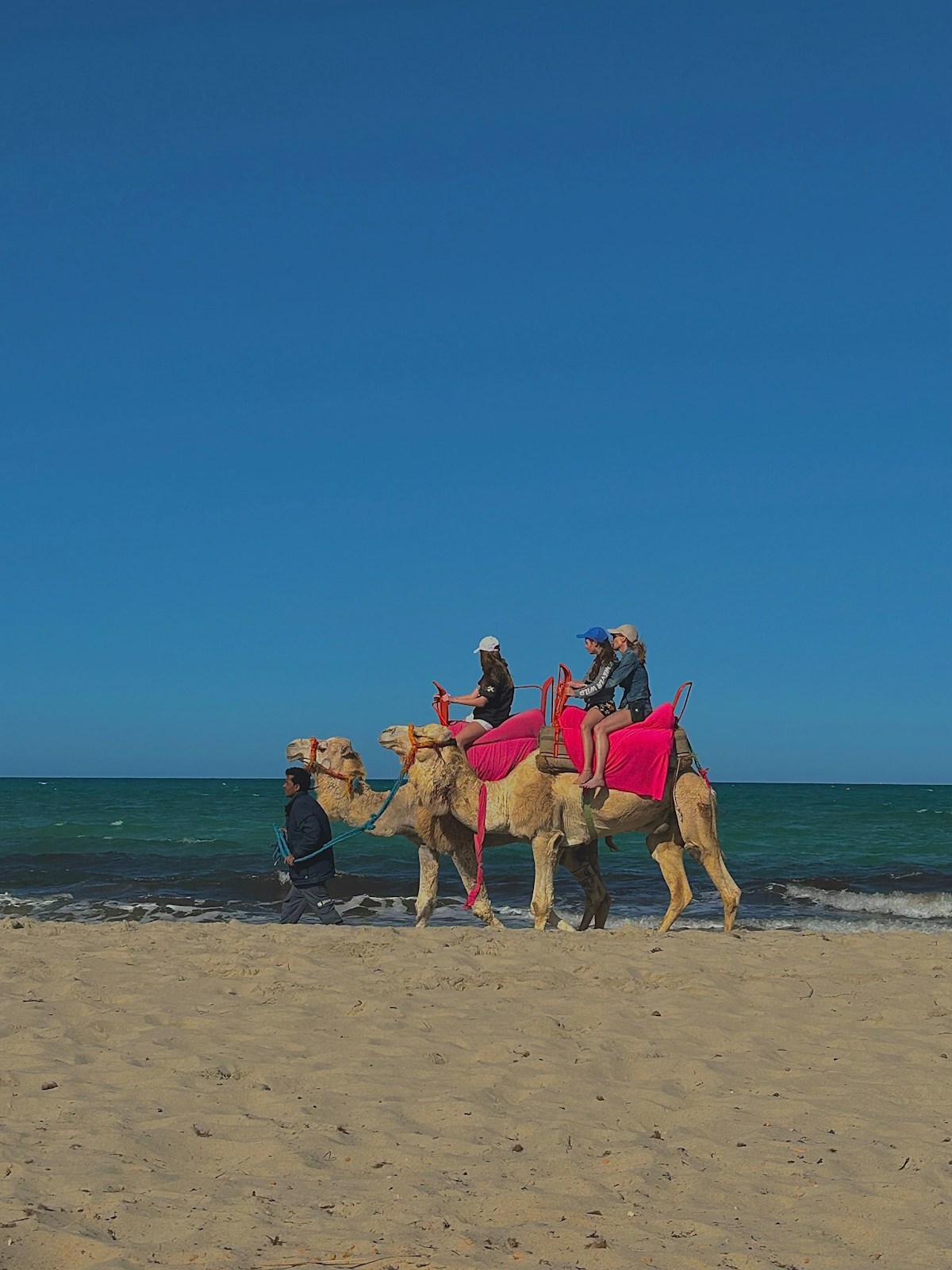
Camel rides on the beach are a fixture of the Djerba tourist experience - operators are found near Sidi Mahares and along the Zone Touristique beachfront. A 30-minute beach ride costs approximately 20-40 TND as of 2026 per person. Horse-drawn carriage (caleche) rides are also available in the resort area.
Getting Around the Island
Bicycle hire - The best way to explore Djerba independently. The island is flat and 20-25 km across. Bicycle hire from Houmt Souk costs approximately 15-25 TND per day as of 2026. Factor in the heat from June to September - start early and carry water.
Scooter hire - Faster than cycling and covers more ground. Scooters hire for approximately 40-70 TND per day as of 2026 from Houmt Souk. A driving licence is typically required.
Local taxis - Available throughout the island; Houmt Souk to Guellala costs approximately 10-15 TND as of 2026. Negotiate the price before departure as meters are not always used.
Car hire - Available at Djerba-Zarzis airport and from agencies in Houmt Souk. Rates from approximately 60-100 TND per day as of 2026. Useful if you are covering the whole island in one day.
Recommended Day Itinerary
08:00 - Arrive Houmt Souk (by taxi from airport or ferry)
08:30 - Houmt Souk medina walk and Borj el Kebir fortress (~2 hours, entry ~3-5 TND)
10:30 - Taxi to El Ghriba Synagogue (~8-10 TND)
11:00 - El Ghriba visit (30-45 min, entry free)
12:00 - Taxi to Guellala (~10-15 TND)
12:30 - Pottery workshops and Guellala Museum (~1.5 hours, museum ~5 TND)
14:00 - Taxi north to Sidi Mahares beach
14:30 - Lunch at beach restaurant (approximately 25-45 TND per person)
15:30 - Beach time; optional camel ride (~20-40 TND)
17:30 - Taxi back to Houmt Souk or airport
Tours and Activities
Organised tours make Djerba’s sites more accessible, particularly if you only have one day:
- Djerba island tours - full-day tours from Houmt Souk typically cover El Ghriba, Guellala, and the beach zone; prices from approximately 40-70 USD per person as of 2026 via GetYourGuide and local operators
- Star Wars filming location tour - the exterior of the Lars homestead in the first Star Wars film was shot near Matmata on the mainland, but several scenes used locations in the Tataouine region south of Djerba; specialist film-location tours are available
- Cooking classes in Djerba - several tour operators offer half-day Djerbian cooking experiences, typically featuring seafood dishes and the island’s distinctive couscous; prices from approximately 50-80 USD per person as of 2026
- Snorkelling and boat trips - glass-bottom boats and snorkelling trips depart from the Zone Touristique beach area; prices from approximately 25-50 TND per person for a 1-2 hour trip as of 2026
For current activity availability and booking on Djerba, browse all tours and activities on GetYourGuide for pricing and availability, or check the widget on this page.
Practical Notes
Best time to visit - April to June and September to November. The sea is warm enough for swimming from May through October. July and August are very hot (35-38°C) but the beaches are at their liveliest. The Ghriba pilgrimage (Lag BaOmer, date varies with the Jewish calendar - typically April or May) draws large crowds; book transport and accommodation well in advance if visiting at that time.
What to bring - Cash in TND - many craft workshops and small restaurants are cash only. Sunscreen and water are essential in summer. A light layer for the synagogue visit. Comfortable shoes for the cobbled medina.
Food on Djerba - Seafood is the island speciality. Restaurant Du Sud near Houmt Souk market serves good fish for approximately 25-45 TND per person. The zone touristique restaurants run 40-70 TND per person. Local cafes in Houmt Souk serve shakshuka, brik, and sandwiches for under 10 TND.
Language - Arabic is the primary language; French is widely understood in tourism areas. Djerbi Arabic has its own dialect distinct from Tunis Arabic. English is spoken at the main tourist sites and in the resort zone.
Djerba rewards those who go beyond the beach. The combination of the Ghriba’s ancient spiritual weight, Guellala’s working craft tradition, and Houmt Souk’s lived-in medina makes it one of the most layered destinations in Tunisia - and the flat island terrain means it is all reachable without difficulty on two wheels or four.
Plan Your Trip
✈️ Book your flights to Tunisia 🛡️ Get travel insurance 📱 Stay connected with an eSIM 🚗 Rent a car