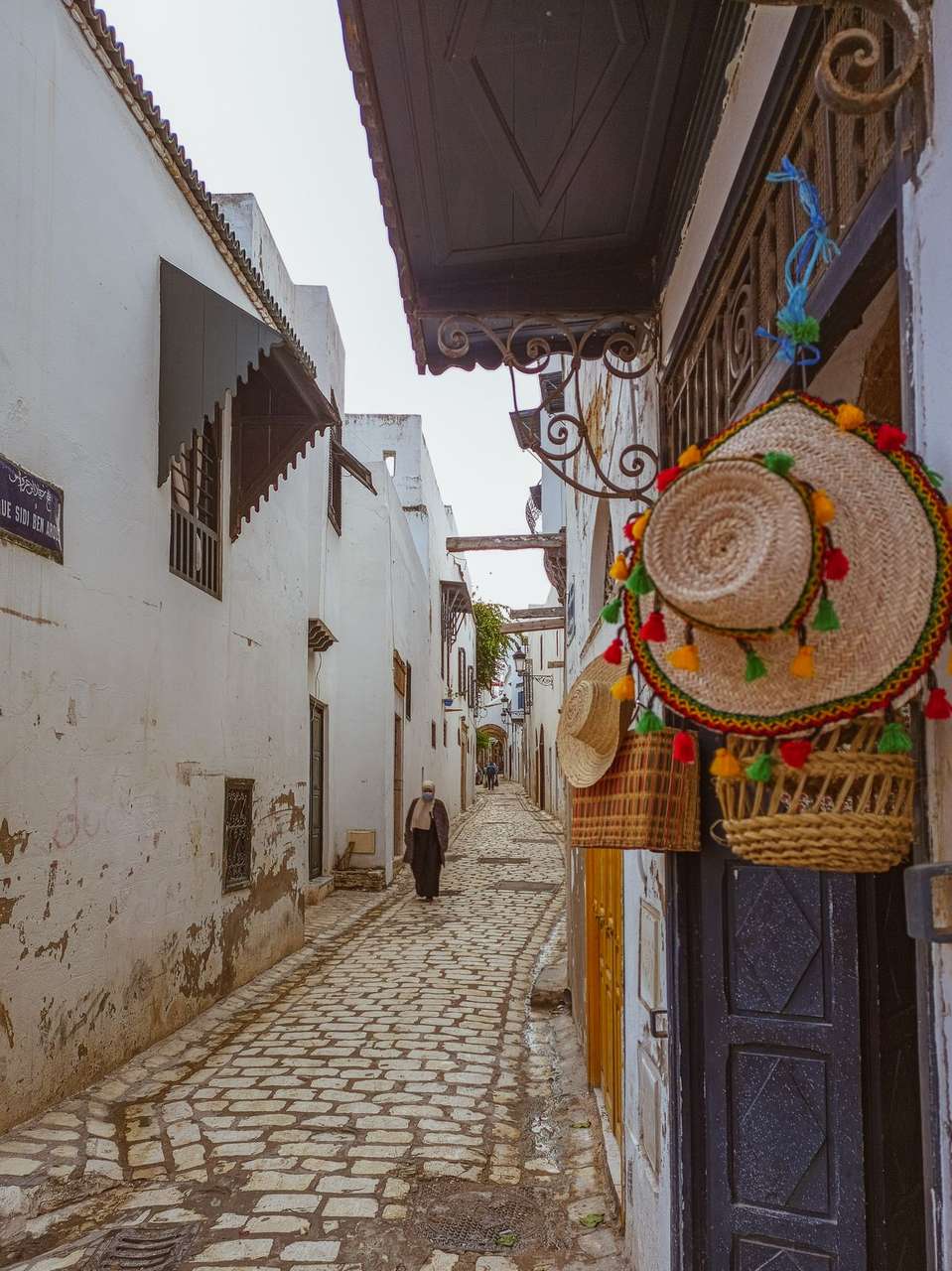
Tunisia sits at a crossroads between Arab, Berber, and Mediterranean cultures. Tunis is a cosmopolitan city where women in headscarves walk past women in jeans, and where cafes serve strong espresso beside glasses of mint tea. That plurality is part of what makes Tunisia a genuinely welcoming destination. But the relaxed surface can obscure rules that matter to your hosts. Understanding them takes no effort and makes every interaction easier.
Dress codes
Religious sites
Tunisia’s mosques, mausoleums, and zawiyas (Sufi shrines) are places of active worship, not tourist attractions. Dress conservatively for all of them: shoulders and knees covered for both men and women, and shoes removed at the door. Women do not need a headscarf at most Tunisian mosques, but carrying a light scarf to cover your hair shows respect and is appreciated.
The Great Mosque of Kairouan (Sidi Uqba Mosque), one of the oldest mosques in Africa and the fourth holiest site in Islam, is a particular case. Non-Muslims may visit the courtyard but cannot enter the prayer hall. Dress requirements are strictly observed at the entrance. The medersas (Islamic schools) around Kairouan and in Tunis, such as the Medersa Mouradia near the Tunis medina, have similar rules.
Synagogues on Djerba, including the El Ghriba synagogue — the oldest in Africa — require modest dress. Women should cover their hair before entering the sanctuary.
Beaches and resorts
Bikinis and swimming trunks are completely normal at Tunisia’s resort beaches: Hammamet, Djerba, La Marsa, and Monastir. The major resort areas and hotels operate essentially by Mediterranean beach norms.
Away from resort zones, cover up when walking through towns. A beach cover-up or light trousers and a t-shirt is the right call in town centres, markets, and medinas. Arriving at a souq in Sfax or walking through Kairouan in a bikini top is considered disrespectful and draws unwanted attention.
Restaurants and everyday settings
Smart-casual is appropriate for most restaurants. The upscale dars (traditional riad-style restaurants) in Tunis — such as Dar El Jeld on Rue Dar El Jeld in the medina — have no formal dress code but attract a well-dressed clientele. Shorts and sandals are fine in casual settings and seafront restaurants.
In rural areas and smaller towns, women wearing loose trousers or long skirts rather than short shorts move through public space more comfortably. This is a practical observation rather than a rule.
Greetings and social customs
Standard greetings
The standard greeting is “As-salamu alaykum” (peace be upon you), answered with “Wa alaykum as-salam.” Tunisians typically respond warmly when visitors attempt even a few words of Arabic or Darija (Tunisian dialect).
Between people who know each other, greetings include handshakes and often two cheek kisses (from right to left), regardless of gender in most urban social settings. As a visitor, follow the other person’s lead. If a Tunisian man does not extend his hand to a woman, he may be observing conservative custom — a slight nod and a hand placed on the heart is the respectful response.
Ramadan behaviour
During Ramadan, eating, drinking, and smoking in public during daylight hours is formally discouraged and in some contexts prohibited for all, not just Muslims. Restaurants in tourist areas generally stay open, but local restaurants typically serve lunch only behind drawn curtains. Showing awareness of the month — keeping food and drinks out of sight in public — is appreciated.
Evening during Ramadan is a different matter: the iftar meal after sunset is a social and festive occasion. Many Tunisian families invite visitors to share the meal. Accept if offered.
Bargaining
Bargaining is expected in medina souqs, from the Souq des Chechias in Tunis to the craft market at Port El Kantaoui in Sousse. The initial price is a negotiating position. Counter with around 60% and settle somewhere in between. Bargaining is a social exchange, not a confrontation: keep it good-humoured.
Fixed prices apply in modern shops, pharmacies, supermarkets, and chain restaurants. Do not bargain there. It wastes everyone’s time and embarrasses the shopkeeper.
Photography
Tunisia is visually rich and most people are photographed without fuss. A few rules matter:
Always ask before photographing people. This is especially important for women in conservative dress, elderly people, and anyone in a medina setting going about daily life. The Arabic phrase “mumkin soura?” (can I take a photo?) works well. A refusal should be accepted immediately.
Military and government buildings are strictly off-limits. Do not photograph police stations, army barracks, border posts, the Presidential Palace in Carthage, or Bourguiba Street government offices. This is enforced and violations have led to detentions.
Mosques from the outside are generally fine to photograph. Interior photography is restricted and sometimes prohibited. Ask the caretaker.
The Tunis medina, Sidi Bou Said, and Djerba are extremely photogenic and generally welcoming to cameras. The Dyers’ Quarter (Souq Essebbaghin) in the Tunis medina and the blue-and-white streets of Sidi Bou Said see heavy camera traffic and shopkeepers are used to it — though a purchase after photographing their wares goes down well.
Religious and cultural sensitivities
Islam in daily life
Around 99% of Tunisians identify as Muslim. The call to prayer (adhan) sounds five times a day from minarets across the country. It is not an inconvenience to be managed — it is part of the rhythm of the place.
Public displays of affection between unmarried couples, including kissing, are technically illegal under Tunisian law and draw negative attention in conservative areas. Tunis, La Marsa, and Gammarth are more relaxed; rural and southern towns less so.
Homosexuality is criminalised under Article 230 of the Tunisian Penal Code. Exercise discretion.
Alcohol
Alcohol is legal and available in Tunisia: at hotel bars, specialist off-licences (look for “magasin specialise”), supermarkets stocking wine, and licensed restaurants. However, alcohol is not universally accepted. Do not drink in public spaces, streets, or anywhere that is not a licensed venue. During Ramadan, some licensed venues restrict service even further.
Tipping culture
Tunisia is a tipping culture, though amounts are modest by Western standards. As a general guide:
- Restaurants: 5—10% in sit-down restaurants; rounding up the bill is fine in cafes
- Taxis: round up to the next whole dinar or add 0.5—1 TND on short journeys
- Hammams and massages: 2—5 TND to the attendant
- Hotel porters: 1—2 TND per bag
- Tour guides: 5—10 TND for a half-day, 10—20 TND for a full day
Tipping at grocery checkouts, pharmacies, and fast food counters is not expected. For a detailed breakdown by venue type and region, see our tipping in Tunisia guide.
Dining etiquette
In restaurants
Tunisian restaurants range from neighbourhood mechouia places to full dar-style dining. A few shared customs apply:
Meals often start without ceremony — dishes arrive when ready rather than all at once. Bread (khobz) appears automatically and is used to scoop food as well as to eat alongside it. Using your right hand to eat is the norm.
Finishing everything on your plate is a compliment to the cook. Leaving a small amount signals you are full rather than dissatisfied.
Tea and coffee culture
Accepting tea or coffee when offered in a shop or home is a social courtesy, not an obligation to buy. The mint tea poured from a height (a performance in itself at traditional cafes on Avenue Habib Bourguiba in Tunis) is sweet, strong, and usually accompanied by pine nuts. Refusing without explanation can seem abrupt. A simple “shukran, la” (thank you, no) with a hand gesture is fine.
Maklouf — traditional Tunisian coffee mixed with orange blossom water — is a local variant worth trying at places like Cafe de Paris in Tunis or any traditional cafe in the medina.
Behaviour in homes
Receiving an invitation to a Tunisian home is common and should be taken seriously as a gesture of genuine welcome.
Remove your shoes at the door unless the host explicitly tells you not to.
Bring something. A box of sweets (halwa or baklava from any patisserie), pastries, or fruit is appropriate. Alcohol is not a standard gift unless you know the family well and know they drink.
Accept food when offered. Refusing food in a Tunisian household is taken personally. If you cannot eat something, a small portion on your plate and a statement that you are full is more graceful than a flat refusal.
Compliment the food. Tunisian cooking — the brik (flaky pastry with egg), the slow-cooked lamb tagines, the harissa — is a source of real pride. Saying “bnin barsha” (very tasty in Tunisian Arabic) will produce a genuine smile.
Gender dynamics vary by household. In some more conservative families, women and men eat separately. Follow the host’s lead.
Punctuality is flexible. Arriving 15—30 minutes after the stated time is not rude — it is normal. Arriving exactly on time may catch your host still cooking.
General courtesies
A few small habits go a long way:
- Greet shopkeepers and stallholders when entering their space, even if you are just browsing
- Bargaining is fine; walking away mid-deal after agreeing a price is not
- Visiting Kairouan on a Friday midday involves navigating around the main Friday prayer congregation — plan your timing around this rather than through it
- Lower your voice near mosques during prayer times
Tunisia rewards visitors who show a basic interest in the culture. Most of what counts as etiquette here comes down to noticing your surroundings and treating people with the same courtesy you would expect at home.