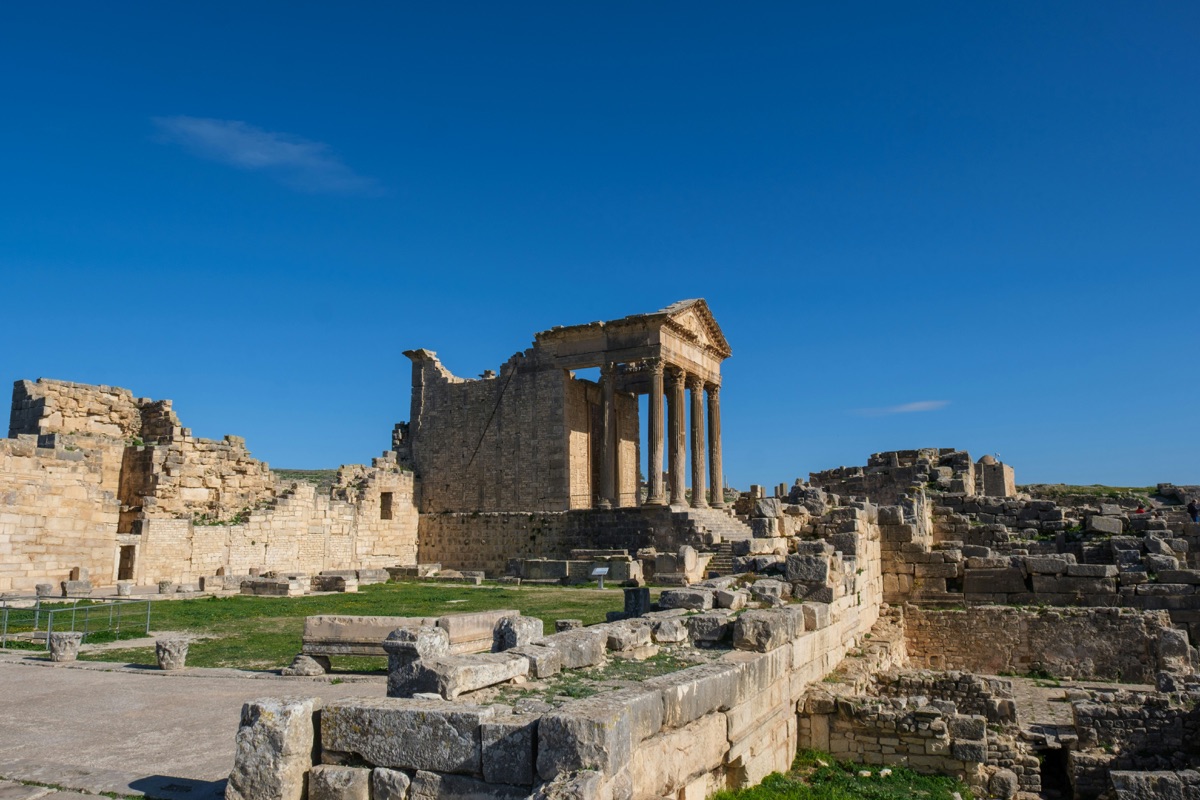
Dougga, known in antiquity as Thugga, is the most complete surviving Roman city in North Africa. It occupies a hillside in northwest Tunisia, 110 kilometres southwest of Tunis, with panoramic views over the Medjerda valley. Unlike many Roman sites that were built over or stripped for stone, Dougga was partly abandoned in the medieval period and relocated in the 1950s, leaving its Roman and Numidian layers intact at ground level.
UNESCO designated Dougga a World Heritage Site in 1997. For a full guide to the site’s attractions, see our Dougga things to do guide.
What a Day Trip to Dougga Includes
A full day trip to Dougga from Tunis typically takes 8 to 9 hours including travel, with 3 to 4 hours on site. Most guided visits cover:
The Capitol (Capitolium): The best-preserved Roman temple at Dougga, dedicated to Jupiter, Juno, and Minerva and dating from 166 CE. Six Corinthian columns support the portico, and the inscription across the frieze names the donor who financed its construction.
The Theatre: A well-preserved Roman theatre with a semicircular seating bank cut into the hillside and a two-storey stage building. Capacity was approximately 3,500. The theatre is still used for occasional cultural events.
The Forum and Market: The forum complex sits below the Capitol and shows the civic centre of Roman Thugga, including bases of honorary columns and the market building.
The Numidian Mausoleum (Mausoleum of Ateban): One of the only surviving Numidian monuments in Tunisia, predating Roman occupation and dating from the 2nd century BCE. It stands at the northern edge of the site and combines Hellenistic, Punic, and Egyptian architectural elements.
The Arch of Septimius Severus: A triumphal arch dating from 205 CE marking the entrance to the Roman town from the main road.
Baths and Houses: Several private bathhouses and villa complexes are partially open, showing floor mosaics and heating systems.
Entry Fees and Opening Hours
Entry fee (as of 2026): approximately 8 TND per adult
Opening hours: approximately 08:00 to 18:00 in summer; 08:00 to 17:00 in winter (confirm on arrival as seasonal hours vary)
Photography: permitted throughout
Time needed: 2 to 3 hours for a thorough visit; 90 minutes for the main monuments
Bring water and wear shoes suitable for uneven stone surfaces. The site has a small cafe near the car park but facilities are limited.
Getting There from Tunis
Dougga is not easily reached by public transport alone, which is why most visitors join guided tours from Tunis:
By tour: A private or shared minibus day trip handles the transport and navigation. Typical departures from Tunis are at 08:00 to 09:00, returning by 17:00 to 18:00.
Independently by public transport: Take a louage from Tunis’s Bab Alioua station toward Téboursouk. From Téboursouk, take a taxi to the Dougga entrance (approximately 10 km, negotiate the fare in advance). The journey takes 2 to 2.5 hours each way and requires some planning.
By rental car: The most flexible option for independent travellers. The drive from Tunis takes approximately 2 hours via the A3 motorway toward Beja and then regional roads. Parking at the site is free.
Combining Dougga with Other Sites
Dougga pairs well with other northern Tunisia destinations on a day trip or multi-day itinerary:
- Bulla Regia (40 km northwest): Roman ruins notable for underground houses with intact mosaic floors. A combined Dougga and Bulla Regia day trip is a popular option among archaeology-focused visitors.
- Thuburnica: A smaller Roman site in the same region, rarely visited and worth combining if you have a full day and private transport.
- Ain Draham (70 km west): A forested hill town in the Khroumirie mountains, useful as a base if you plan multiple days in northwest Tunisia.
If you are also planning to visit Kairouan, El Jem, or the medinas in Tunis and Sousse, see our Tunisia UNESCO World Heritage Sites guide for a full overview and circuit options.
Visitor Tips
- Hire a local guide on site: Independent guides are available at the entrance for a negotiated fee of approximately 20 to 30 TND for a 90-minute walk. They provide context on Numidian and Roman history that significantly improves the visit.
- Wear sun protection: The site is exposed with very little shade. A hat and sunscreen are essential from April onward.
- Bring cash: Card payments are not reliably available at the ticket office or for on-site guides.
- Go in the morning: The afternoon light is harsh in summer and temperatures peak after noon. A morning visit is consistently more comfortable.
- Check festival schedules: Occasional classical music and theatre events are held in the Roman theatre; visiting during a performance requires advance tickets but is a memorable experience.
For guided tours from Tunis, search GetYourGuide for operators covering Dougga. Private day trips typically cost from approximately 50 to 80 USD per person depending on group size.