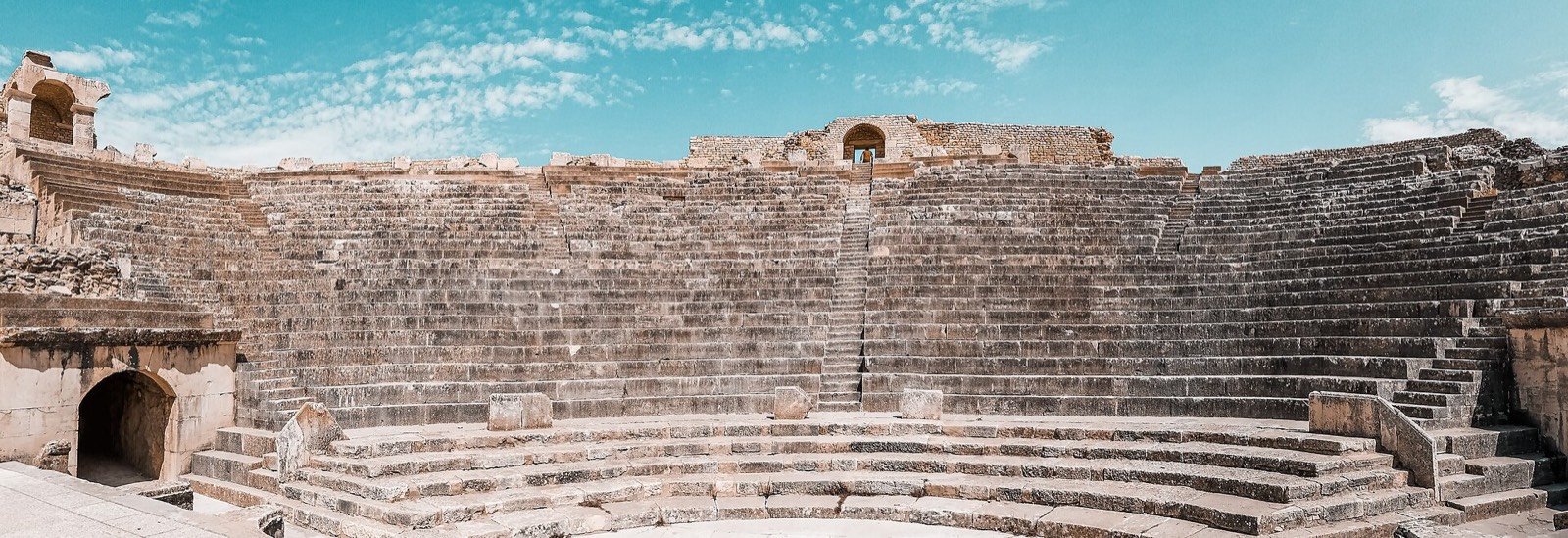
The 7 best Roman sites in Tunisia are Dougga, El Jem, Carthage, Bulla Regia, Sbeitla, Thuburbo Majus and Kerkuane (a Punic town the Romans later absorbed). Dougga and El Jem are the strongest first choices. All seven can be reached from Tunis or Sousse by car, train or louage.
Tunisia was the Roman province of Africa Proconsularis, the empire’s granary, and it kept more standing Roman architecture than almost anywhere in the Mediterranean. Entry fees are low, crowds are thin outside July and August, and you can often walk a forum alone. Here is how we rank them, with practical details for each.
1. Dougga: the best complete Roman town
Dougga (ancient Thugga) climbs a hillside above olive fields about 120 km from Tunis. It is the best-preserved Roman small town in North Africa and a UNESCO World Heritage Site. The theatre seats about 3,500, the Capitol towers over the forum, and the Libyco-Punic mausoleum shows the Numidian layer under the Roman one.
Entry: approximately 15 TND as of 2026. Time needed: 2 to 3 hours. Best time: October to March, when the valley is green and the hillside is cool. Our Dougga visitor guide covers hours and transport, and the Dougga Roman ruins tour is the easy option without a car. Browse tours from Tunis for current departures, or check hotels near Dougga if you want to stay overnight.
2. El Jem: the biggest amphitheatre in Africa
The El Jem amphitheatre was built around 238 AD and held roughly 35,000 spectators, making it one of the largest Roman arenas anywhere and among the best preserved. You can climb the tiers, walk the underground passages where animals and gladiators waited, and see the arena floor from the top. It is also a UNESCO site.
Entry: approximately 12 TND as of 2026, combined with the museum, which holds good mosaics. Getting there: trains from Sousse take about an hour, from Tunis 2.5 to 3 hours. Time needed: 1.5 to 2 hours. Read the El Jem guide, see the El Jem amphitheatre tour, or book El Jem tours and activities.
3. Carthage: the city Rome destroyed and rebuilt
Carthage is scattered across a seaside suburb of Tunis rather than one fenced site. You get the Antonine Baths beside the sea, the Roman villas and Odeon on Byrsa hill, the Punic tophet and the ports. Rome razed the Punic city in 146 BC and later rebuilt it as a major provincial capital. The site is UNESCO listed.
Entry: approximately 12 TND for non-residents as of 2026, with hours of 08:00 to 18:00 in summer and 08:30 to 17:00 in winter. Time needed: half a day. Pair it with Sidi Bou Said, 15 minutes away. Our Carthage ruins guide maps the zones, and the Tunis, Carthage and Sidi Bou Said tour joins them up. If you are staying in the capital, see where to stay in Tunis.
4. Bulla Regia: the underground villas
Bulla Regia, in the northwest near Jendouba, is the one Roman site with no equal. Wealthy residents built whole floors underground to escape summer heat, and several of these villas still have columns, mosaics and vaulted rooms you can walk through. The House of the Hunt and the House of the Fishing are the best known.
Time needed: 1.5 to 2 hours. Getting there: it is about 150 km from Tunis, so it works as part of a northwest loop with Dougga, which sits roughly 90 km away. Our day trips from Tunis page shows how to combine the northwestern sites. Best time: spring or autumn, though the underground rooms stay cool even in summer.
5. Sbeitla: three temples in a row
Sbeitla (ancient Sufetula) sits in the central steppe, roughly 220 km from Tunis. Its forum is lined by three side-by-side temples to Jupiter, Juno and Minerva, one of the most photogenic arrangements in North Africa. There are also a triumphal arch, a theatre and early Christian basilicas with baptismal fonts.
Time needed: 1.5 hours. Best time: early morning, when the stone is golden and the site is quiet. It suits travellers on a longer route between Kairouan and Tozeur, and it is rarely crowded. See our Kairouan guide for the nearest big base.
6. Thuburbo Majus: the easy half-day from Tunis
Thuburbo Majus is about 65 km southwest of Tunis, close enough for a half-day trip. It has a restored forum, a Capitol with tall columns, public baths with mosaic floors and the Temple of Mercury. It gets far fewer visitors than Carthage, so you often have the paving to yourself.
Time needed: 1 to 1.5 hours. Combine with: Dougga, which is a logical stop on the same road. If you want to drive yourself, our Tunisia car rental guide covers operators and what to expect on the road.
7. Kerkuane: the Punic town on Cap Bon
Kerkuane is not Roman, but we include it because it completes the story. It is the only Punic town in the Mediterranean to survive largely intact, abandoned in the 3rd century BC and never built over. You can walk streets, see houses with bathtubs and read the layout of a Carthaginian town. It is a UNESCO site.
Getting there: about 1 hour 45 minutes from Tunis on the Cap Bon peninsula. Our Kerkuane guide explains how to reach it, and it combines well with Nabeul and the coast.
How to link the sites into a route
Two practical loops work well. For the north, take Carthage, Thuburbo Majus, Dougga and Bulla Regia over two days, sleeping near Dougga or in Tunis. For the south, take Sousse, El Jem and Sbeitla with a night in Kairouan. Our UNESCO World Heritage Sites itinerary strings the biggest names together, and the 10 days in Tunisia plan fits most of the sites above.
Photo: Monaam Ben Fredj / Wikimedia Commons, CC BY-SA 4.0.
